Focus Makes a Difference to Fulfilment

Decades ago, I was in a relationship that reflected the cycles associated with intimate partner abuse. It was crazymaking. I read every book available and sought help from numerous professionals. Endless seeking of information got in the way of doing what was needed. Leaving. My confusion was in my head. In my being I knew that what was being said and done wasn’t loving. That simplicity was all I truly needed. The rest was unnecessary complexity.

I see those same internal psychological dynamics operating in client presentations. People say they want something, but instead of taking action to make that happen, they get lost in a sea of thought and information from youtube channels, Instagram, internet sites, other people’s comments, professionals and self help books. Instead of information informing personal experience so that we can take action more confidently, for many its endless elaboration leads nowhere and action is stymied. The simplicity is that if something doesn’t feel right, then something in it isn’t. Trust that.
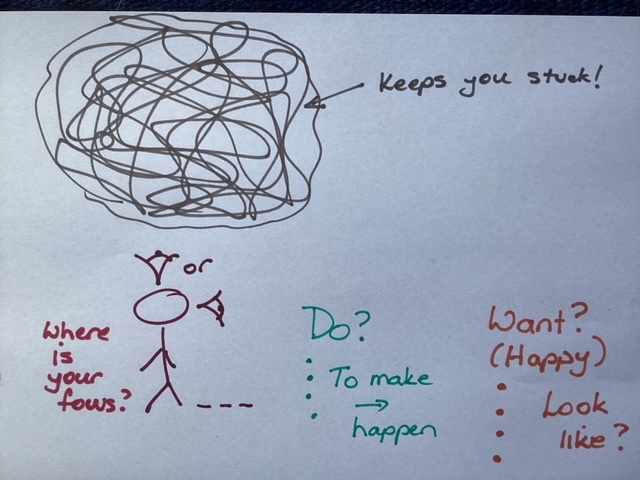
I often use this graphic in my consultations to reflect the internal dynamics of what happens. If we get out of our heads, logic usually informs what needs to be done. Maybe that is leaving a relationship, changing a job, moving someone out, getting on with studies, letting go of someone. Instead of working with the logic of what we know however, many people flip into their heads, rummaging through the various information they have read, what others will think, why they can’t do something, etc. etc. No one ever succeeded in life via that route. They succeed by getting on with things, even if it is new, they haven’t done it before and they are a bit afraid. Courage outweighs unfamiliarity. Because that is how human beings navigate the ‘new’, the ‘unexpected’, the ‘needed’. They get on with it, maybe not perfectly, maybe not even successfully, but they focus on what needs doing and do it.

Just as how we read has changed with the introduction of screen based print and entertainment, so too has how we solve problems. In reading, our automatic (learned to perfection) habit used to be deep attention, neural processing moving from left to right. Now, our automatic (learned to perfection) habit is to quickly scan haphazardly moving our eyes to differing locations, extracting info bytes and departing 3 minutes later. For many, deep reading takes more effort than it used to. With an exponential growth in information, our automatic problem solving skills have also changed. Once, we would have listened to our internal logic about matters and acted. Now we automatically search for the next information source endlessly talking, gathering (info bytes), watching …. but not moving. Our internal logic and wisdom is drowned out by the noise occupying our minds. We are stuck.

Journalling can be very effective in reconnecting with internal logic and taking practical steps. The first question is what do you want? What would your life look like if you had it? What would you have to learn to make it happen? What would you have to give up? Be specific. Give yourself permission to be honest and don’t get distracted by thoughts that critique what surfaces. Trust the train of thought that surfaces. You are not committing. You are just exploring.

Next, list all that you would have to do to make what you want happen? Again don’t get caught up in censoring your capacities and abilities. How do you feel about what you have written? Is trusting yourself and doing what’s right for you a possibility? Write into the apprehension, you may find it doesn’t have a leg to stand on.

When faced with a challenge are you automatically deviating into your head and rattling around in there instead of taking one small step? Because that’s all living is about. Small steps. Taking them one step at a time. Just like a baby learning to walk – thank goodness they can’t read before the task of walking! One step. Learn. Modify. Next step.


The Smarter Part of Us (Part 1)

The title of this blog post came from the mouth of a young person who had come to see me because of the dangerous nature of the thinking that had crossed their mind.

I drew the line below on the whiteboard in my office.

I often draw a line to show people that we are all following our thinking all day long. And as the quality of our thinking fluctuates so does the feeling we experience. Think harried thoughts about all the tasks that need doing and you will feel harried. Think angry thoughts and you will feel angry. Think grateful thoughts and you will feel grateful. Be open to doing whatever comes to mind and you will feel calm and relaxed. In the particular instance above, the young person had been going about their day when something occurred and their thinking derailed down a dark alley.

Interestingly, they didn’t act on that thinking – otherwise they wouldn’t be in my office.

I commented on this and asked what thinking came into their mind after the dark thoughts.

‘That ‘that thinking’ wouldn’t end well.’ Yep, that was true.

‘That I needed to get myself out of there.’ Made sense.

‘That I needed to speak to someone.’ Wise.

‘Where did all this thinking come from,’ I asked (pointing to the rising line after the unhappy face). To which they replied with the title of this blog post.

A ‘smarter part of us’, naturally surfacing, no effort, no struggle to change our thinking, just spontaneously erupting of its own accord to lead us back to a clearer, calmer state of mind. Everyone has it. All the young people who come in to my office concerned about self harming or suicide have it. So do the adults who know they are struggling but sense there is more. Most of us don’t notice it. Some listen to it, some don’t. How have we got to this point in our evolution in which we are largely ignorant of the workings of our ‘wired in’ resiliency and mental health?

Do we notice the relationship between our thoughts and our feelings? Can we see that our thinking is the mediator of all experience, whether it be of a rainy day or of scary thinking crossing our mind? Do we notice that thinking fluctuates? Do we notice the powerful change brought about by a split second shift in our thinking that arrived without deliberately conjuring it up? How does that happen? Do we notice the impact of insights on our habitual trains of thought? Do we wonder where shifts in thinking come from? Psychology tells us that once we have started along a negative thinking path it tends to keep going in the same direction. What it fails to remark upon and get curious about is the fact that our innate mental health never fails to offer up a thought that will bring us back to our senses – if we choose to follow it.

So much untapped and unexplored depth to the healthy human system of psychological functioning, already operating in everyone, but for most, outside our consciousness. Experiencing more of our mental health doesn’t require learning techniques to build anything in us, everything is already inbuilt. Experiencing more of what is inbuilt is simply about becoming aware of it, of having conversations that bring focus to all that operates in human experience and not just the slivers that we have dissected out to examine. Experiencing greater mental health comes with increased awareness of the fuller picture of the processes at play in psychological functioning.

Waking up. A moment of waking up to what already exists is all that is required to a deeper, more stable experience of our mental health. Seeing that we are experiencing thought, noticing a sudden shift in vitality and seeing its true source (effortless thought replacing rumination), realizing we can trust the thoughts that originate deeper within us more than the ones making noise in our heads, are all moments with powerful repercussions.

If you would like to experience greater depths of yourself (and not just what you were conditioned to believe), or are genuinely open to experiencing more fulfilment and satisfaction with your life, mentoring consultations are available with myself either in person or via Zoom. Please feel free to make contact at georginamavor@outlook.com.

Disentangling

In the world of personal growth, there are ‘many roads to Rome’. My particular pathway to liberation of the self and greater authenticity is journalling. The practice supported me to successfully navigate the dismantling of an emotionally unhealthy relationship and create a wonderful life. It is where I go to process parenting issues or questions about the direction of my work. It is also where I go to record insights as they come, observations about how our inner world works, and moments of intense gratefulness for the gift of being alive.

Over the years I have learned a lot from journalling. I have learned which thoughts to follow, and which ones to allow to float on by – another one always enters. I have learned to trust the feelings of my body and what they are telling me. I have learned to sense whether I am speaking from memory irrelevant to the moment or speaking from deeper wisdom within. I have learned to respect and trust my intelligence. I have learned that tension reflects a person’s ability to hear or not. I have learned to listen for conversations open to engagement and to speak when moved. I have also learned to not speak when learned habits from the past dictate that I should. I have learned to create healthy boundaries and to stay out of other people’s psychological entanglements unless they ask for help. I have learned to trust life instead of fear it.

When I work with clients I take note of the psychological entanglements some people get caught up in when speaking. Conversation patterns generated in families of origin, reflective of class, or created in response to trauma, are revealed. Some people have unconsciously learned to avoid the knowledge and wisdom accumulated through experience. These people have a ‘teflon’ relationship to their inner truth and the way they answer questions reveals this. Whilst others consciously reflect and speak from the accumulated knowledge and wisdom within. When someone speaks ‘with substance’ I can hear and feel the truth of it. When someone responds with a ‘teflon’ response it is as if they begin to move in the direction of what they know but at the last minute slide away. Somewhere they have learned to be afraid of what they know.

‘What activities do you like to do that make you feel good?’ -|-> (Authentic) ‘Snorkelling, I love the feeling of mystery when I am underwater and I never know what fish will be around on the day.’ .|C> (Teflon) ‘I don’t know, I don’t enjoy anything.’ On attempting a different pathway in, a childhood memory comes to mind which then leads to a surprising recall of something they enjoy doing as an adult.

‘What do you want to do about the marriage?’ -|-> (Authentic) ‘I’m done. I can’t do this anymore. It’s time to move forward.’ .|C> (Teflon) ‘He says he wants to change and make the marriage work but then he says its my fault because I never agree to what he wants to do.’ In this response, a speaker’s attention has been diverted to the words of their partner instead of their own.

‘Wow, you must be feeling really sad.’ -|-> (Authentic) ‘Yes, she has been my constant companion for over 20 years. I will miss her a lot.’ .|C> (Teflon) ‘No, I will be fine.’ As tears are swiped away.

Each of these ‘teflon’ responses reflects the activity of thoughts learned in the past entangling and contaminating present moment authenticity, wisdom and experience. In any moment we are either experiencing the truest expression of ourselves or it is contaminated by something we have learned, in the past, to think.

Many women have been conditioned to think of themselves as not the decision makers, as not intelligent and therefore not the person in charge, and as caring for things that are unimportant to society. All of this is not true. Society, families, relationships, and selves, need the voices from the depths of our truth. Journalling is one way to familiarise ourselves with the timbre and feel of that voice and to know when it has become entangled with beliefs and thoughts created in the past and innocently carried forward contaminating the present moment experience.

If you are interested in learning and experiencing how journalling can support you to become aware of the deeper, secure self that exists within everyone so that you can be in the world with greater confidence and faith in yourself, I am running a series of introductory workshops, in person and on line, over the coming months. All workshops will be posted on my facebook page https://www.facebook.com/GeorginaMavor.

I don’t know …. Part 2

Accepting ‘I don’t know’ in response to a mind filled with questions and problems was just the first step in hearing solutions to the issues I faced with my final client in my previous post. Many traditional psychotherapies now include acceptance as one of the steps in living a more psychologically flexible life. Acceptance entails two components. The first is acceptance of life as it is. The second is acceptance of what our mind understands (or not) about it. If my life requires that I work full time in order meet my financial commitments, feed all members of the family, keep us safe and secure in our home, etc. then accepting enables me to do what is needed. Don’t accept them and I occupy a fantasy world from which I am easily frustrated when the realities of life intrude. When we accept physical reality, our natural intelligence provides the ideas and thoughts needed. Get caught up in our heads, however, and the solutions to physical reality are blocked. They are still there, but our attention is elsewhere.

Now, I know that I can work, and that I can work at whatever if need be. So when I am faced with finding full time work, my mind doesn’t flip into a conniption about the possibility or impossibility of that. Instead, it automatically opens up to ideas. But what about when I come across problems in which I am not so well versed? Ones like how to respond to client problems I am unfamiliar with, or how to respond to a family member in domestic violence, or how to respond to a life threatening health condition? Problems in which I have no prior knowledge or are seemingly impossible to solve?

A busy mind is just as unhelpful in these circumstances as it is to more easily solved individual issues. It clouds access to whatever we need in the moment to move forward, whether that be into action or a shift into deeper understanding. Just as consciously acknowledging the physical requirements of life can open up the mind, so too can acceptance of ‘I don’t know’. Acceptance of ‘I don’t know’ brings the busyness of our minds to a halt and opens it up to fresh ideas.

But consider our learning around ‘I don’t know’? How many of us have been yelled at, hit, shamed, made to stand in the corner, sent to our rooms, made to stand outside a classroom, etc. because we didn’t know? In my mind, our experiences with ‘I don’t know’ is partially behind most people’s psychological habit of venturing into excessive thinking when confronted with a problem. We have learned that a statement of the truth ‘I don’t know’ is unsafe and so we psychologically go looking, usually for a solution that we think will appease the person who has asked the question.

When I stray into a busy mind, I am looking for understanding that solves everything. I do it because I have learned that when I either spoke my truth or I responded with ‘I don’t know’ someone else was very unhappy. As a child, if being truthful didn’t appease others, then I only had one other psychological place to go – out there. The experience of ‘I don’t know’ morphed into a mental habit of turn away from my own wisdom/truth and seek outside. But looking ‘out there’ for understanding and solutions accelerates thinking and takes us away from the clarity we seek. Clarity is found in a slow mind. Mental habits learned from our childhood experiences with ‘I don’t know’ hinder the clarity we seek.

Notice when your mind is busily searching for understanding everywhere but within your own wisdom/truth. Turn around, speak your truth and accept ‘I don’t know’. Go about your life and be grateful for the insights that will come if needed. Practise acceptance of ‘I don’t know’. See what happens when you reclaim the truth that ‘I don’t know’ is healthier and wiser than trying to pretend we know it all, or that we know nothing and other people know it all. Experiment with voicing ‘I don’t know’ without giving reasons. If we don’t know, we don’t know. Experiment with living life from not knowing. Reclaim the power of speaking our truth of ‘I don’t know’ when that is the case. Experience the peace, calm and insights that often follow.

Photo: Matt Walsh, Unsplash.