The title of this blog post came from the mouth of a young person who had come to see me because of the dangerous nature of the thinking that had crossed their mind.
I drew the line below on the whiteboard in my office.
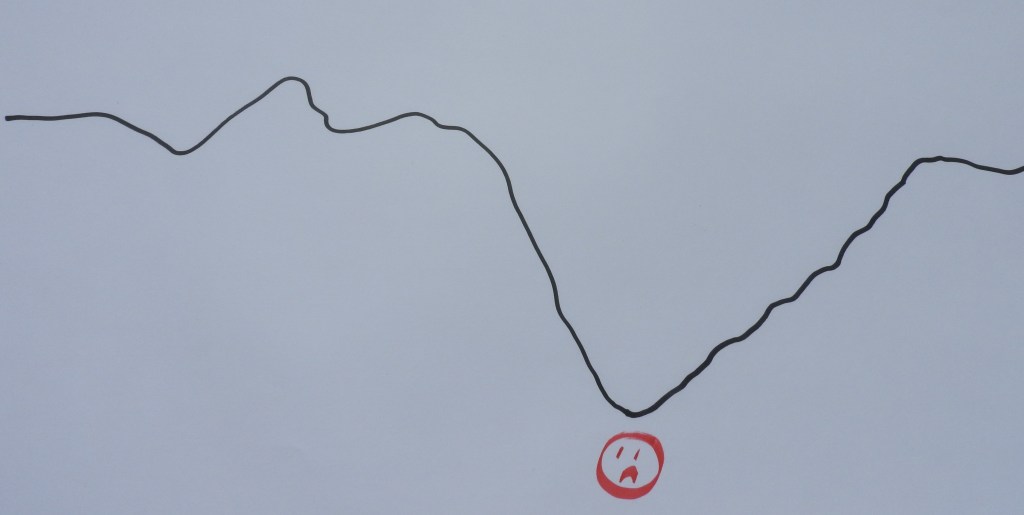
I often draw a line to show people that we are all following our thinking all day long. And as the quality of our thinking fluctuates so does the feeling we experience. Think harried thoughts about all the tasks that need doing and you will feel harried. Think angry thoughts and you will feel angry. Think grateful thoughts and you will feel grateful. Be open to doing whatever comes to mind and you will feel calm and relaxed. In the particular instance above, the young person had been going about their day when something occurred and their thinking derailed down a dark alley.
Interestingly, they didn’t act on that thinking – otherwise they wouldn’t be in my office.
I commented on this and asked what thinking came into their mind after the dark thoughts.
‘That ‘that thinking’ wouldn’t end well.’ Yep, that was true.
‘That I needed to get myself out of there.’ Made sense.
‘That I needed to speak to someone.’ Wise.
‘Where did all this thinking come from,’ I asked (pointing to the rising line after the unhappy face). To which they replied with the title of this blog post.
A ‘smarter part of us’, naturally surfacing, no effort, no struggle to change our thinking, just spontaneously erupting of its own accord to lead us back to a clearer, calmer state of mind. Everyone has it. All the young people who come in to my office concerned about self harming or suicide have it. So do the adults who know they are struggling but sense there is more. Most of us don’t notice it. Some listen to it, some don’t. How have we got to this point in our evolution in which we are largely ignorant of the workings of our ‘wired in’ resiliency and mental health?
Do we notice the relationship between our thoughts and our feelings? Can we see that our thinking is the mediator of all experience, whether it be of a rainy day or of scary thinking crossing our mind? Do we notice that thinking fluctuates? Do we notice the powerful change brought about by a split second shift in our thinking that arrived without deliberately conjuring it up? How does that happen? Do we notice the impact of insights on our habitual trains of thought? Do we wonder where shifts in thinking come from? Psychology tells us that once we have started along a negative thinking path it tends to keep going in the same direction. What it fails to remark upon and get curious about is the fact that our innate mental health never fails to offer up a thought that will bring us back to our senses – if we choose to follow it.
So much untapped and unexplored depth to the healthy human system of psychological functioning, already operating in everyone, but for most, outside our consciousness. Experiencing more of our mental health doesn’t require learning techniques to build anything in us, everything is already inbuilt. Experiencing more of what is inbuilt is simply about becoming aware of it, of having conversations that bring focus to all that operates in human experience and not just the slivers that we have dissected out to examine. Experiencing greater mental health comes with increased awareness of the fuller picture of the processes at play in psychological functioning.
Waking up. A moment of waking up to what already exists is all that is required to a deeper, more stable experience of our mental health. Seeing that we are experiencing thought, noticing a sudden shift in vitality and seeing its true source (effortless thought replacing rumination), realizing we can trust the thoughts that originate deeper within us more than the ones making noise in our heads, are all moments with powerful repercussions.
If you would like to experience greater depths of yourself (and not just what you were conditioned to believe), or are genuinely open to experiencing more fulfilment and satisfaction with your life, mentoring consultations are available with myself either in person or via Zoom. Please feel free to make contact at georginamavor@outlook.com.
 Georgina Mavor