An Unsent Letter to Past Love

Today is the first year anniversary of the death of my daughter’s father. He’d been in my life for 28 years. We were not a good fit. It was acrimonious for over 2 decades. I hadn’t spoken to him in the 2 years prior to his death.

I’ve journalled about this relationship many times. About it’s pain, about the feelings I had not been able to access or honour, about my part in the suffering.

Recently, a thought suggested that I write an unsent letter to him. Unsent letters are powerful journalling techniques for healing relationships with people and issues that can’t be conversed with directly. They support internal shifts that further personal healing.

Mel Robbins, in her book ‘The Let Them Theory’ dedicates several well-written, expertly informed chapters on relationships. I recommend them to anyone struggling with a relationship, but be warned, the chapters focus on you – how to influence, and if necessary, make black and white decisions about your future. She continually asserts we can only control what we think, how we respond to our feelings, and what we do. We can’t control other adults, including those we love.

When you have done what you can to influence the behaviour of another adult and nothing changes, the time comes when you must decide if the behaviours of your loved one are ‘deal breakers’ – something you can live with for the rest of your life, or not. Answering the question about whether our partner’s perspective is a deal breaker or not, brushes up against our deeper, often unspoken visions we have for our lives.

An inspiring example of a conversation in which one party checks out whether their partner is on the same page regarding their future is provided. The conversation validates what the person enjoys in the relationship, their own deeper vision, and the worth of time and energy – our life.

I pondered what I would say in an unsent letter to my former partner if I wrote it from these three points. First, if I stated how much I valued his early generous showering of gifts to demonstrate his love. How I was enriched through travel to different parts of the world, of having the financial freedom to pursue business ventures, and of meeting his extended biological family, and adopted families in third world countries. To enjoy exquisite food in fine restaurants, and to invest in philanthropic projects. But also to be honest about my need for deeper companionship, a broader range of mutual friends, and a family life that involved loving children. Finally, to then speak of my ongoing investment of my life energy and time in our relationship only if I knew elements of my deeper vision for my life could be integrated into our shared life. And to accept his ‘no’ if the vision for his life was completely different to mine.

In imagining that unsent letter, I felt myself settle internally. I felt respect and compassion permeate my being – for myself and for him – 20 years after the severance that eventually came. I spoke truth in that imagined letter. Separate individual needs existed alongside shared companionship. Gaps also existed. Writing can help us to make decisions from a mind that sees it all clearly. Mel Robbins’s chapters provided truths and questions that allowed me to explore it all.

Mentally writing that letter made a difference. I may now use a quiet moment to write it more fully. Nearly a year after his death, an unsent letter allows him to ‘rest in peace’ in my heart and my heart benefits.

Learn from the learning of others. Books like the one written by Mel Robbins are a gift. But their benefits are only half reaped if we don’t work with them. ‘Let Them’ write books, then ‘Let Me’ explore how it fits with what sits in me. How does what they say apply to me? Does what sits in your own repertoire of untapped wisdom from experience resonate? Using other people’s words to explore your own untoiled inner realms brings more of you alive. Using other people’s inspiring knowledge, bring more of yourself to the page, and grow.
Muffled

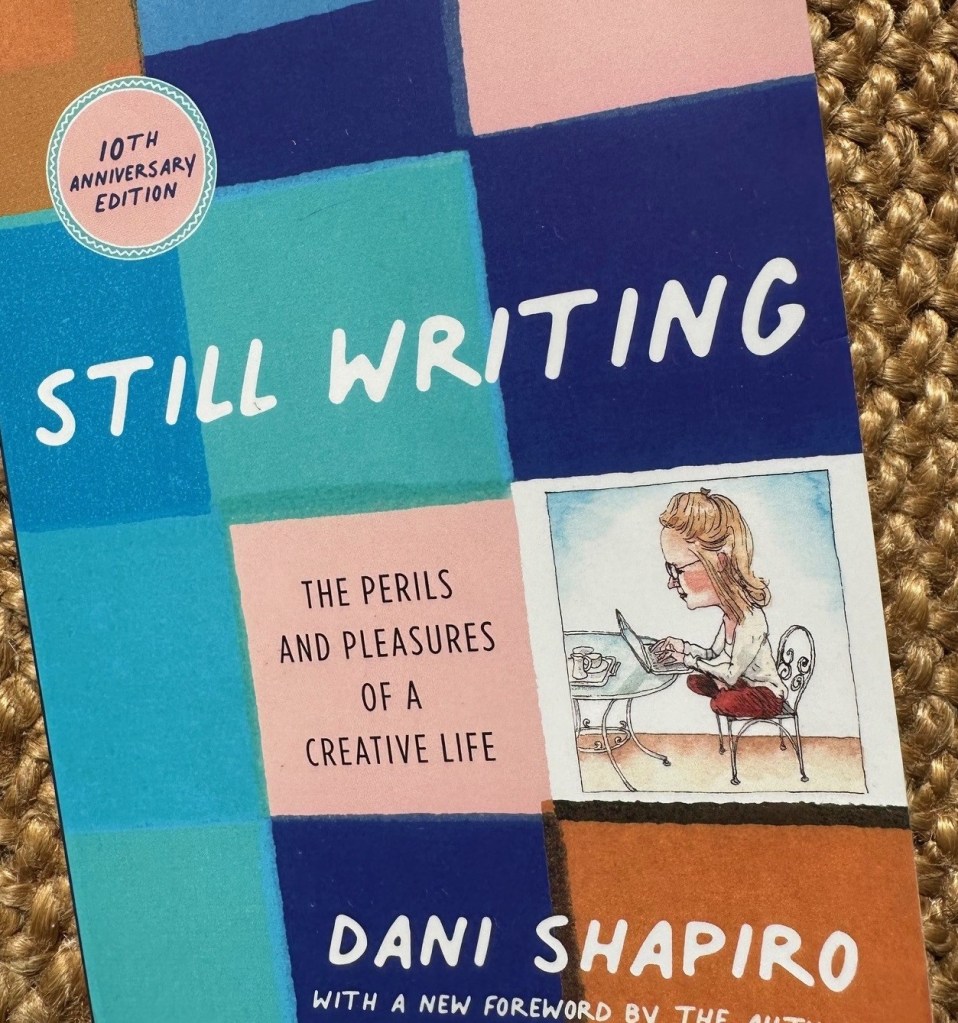
In her book ‘Still Writing – The Perils and Pleasures of a Creative Life’, Dani Shapiro writes about her overuse of the word ‘muffled’ in one of her novels. She realises that in unconsciously repeating the word, she is not close enough to the interior life of her main character.

None of us are close enough to the interior life of the main character in our lives – ourselves. Socialisation, early attachment, temperament, and life experiences all play a significant part in creating psychological obstacles to that realm. We develop habits in keeping ourselves distant from it and we learn ways of communicating and relating that come from thoughts filed away in heads guillotined from what we know in our being.

Earlier last week I was interviewed for a counselling position servicing people with extensive needs. I was asked if I had worked with people who lived with Disassociative Identity Disorder or PTSD. Instead of talking about my lived experience of working with these clients, I spoke from the head, and as I spoke I could feel the energy of genuine conversation depart.

Why did I not talk about my experience with listening? About my experience with hearing each person’s story and validating their hero’s journey with survival? With the difficulties in countering the medical model’s interpretation and the sense of hopelessness it brings? With listening for small ‘windows’ in which to open up different ways of understanding? Of the challenges in creating a safe space and of the stretch I must make if I am to grow enough for them? And all this before embarking on the tools and techniques psychologists are trained in.

Because I forgot to get close to my interior life, the repository of what I know from lived experience. I had forgotten to have a conversation with myself in my journal about what I know about my work with this client group. I had forgotten to harvest my experience; my knowing; my wisdom.

Whether we are writing a book, or being interviewed, or parenting children, or talking with our loved one, none of us escape the potential to fall into the trap of evading the depth and breadth of our own interior life. And when we do, we don’t ‘ring true’. Our words don’t resonate, not with ourselves, nor with others.

Journal writing has been my portal for getting closer to and clearer from my interior life. That job interview reveals I have further to go. How can we talk about what WE consciously know if we don’t turn to the vast amount of unconscious material within and ask? A job interview is not the place to explore what I know. There isn’t the time – to develop rapport or to follow trains of thought until wisdom is revealed. The stakes are too high. And not enough inner exploration has been done to truly ascertain ‘fit’.

Whenever we need to relate to another about something important, it’s important to distill our inner reality about the situation before we embark upon an exchange of feelings, needs, and wants. What is your truth about your relationship with a job? Another person? A responsibility? What needs and wants are tangled up with that ‘other’? Should they be met in that relationship or elsewhere? What might the ‘other’ want from you? What do you want to give?

If we don’t take time to explore our interior lives we can present as ‘muffled’ or at the other extreme ‘rigid’. Familiarising ourselves with our interior realities provides a starting point, one that feels ‘real’, and one from which an exchange, an openness to altering, can occur. Get closer to the interior repository of your lived experience. Write about it, explore how the threads come together and reap the insights that land – before sharing it with another.

Bending Reality Out of Shape

When people come into counselling, I suspect they think that if we just talk about everything, that in some miraculous way, it ‘fixes up’ the content of whatever is going on. The problem is there is SOOOO MUCH going on.

People not liking what we have done, people wanting more from us, unhealthy workplaces, poor relationships, addictions, people dying, sickness, struggling children … the list is endless. All of these issues benefit from a bigger perspective conversation. But the amount of time this would take is unreasonable, and new ‘problems’ surface along the way.

As part of her current More Signal, Less Noise 5 Day training Barbara Patterson presented a simple understanding of how everyone perceives in the moment – including ourselves. We are either interpreting life (and ourselves) from clarity, or we are interpreting from an agitated internal state and our thinking distorts reality. It bends it out of shape.

See the actions of a family member in a clear state and we see their acts of kindness and care. See it from an agitated state, and we distort our attention and thinking, catastrophising one small detail. See our own agitated internal state from clarity and we experience compassion. See the same internal state from agitation and we distort our experience into shame. Sensing whether ourselves and/or others have a calm internal climate or an agitated one, makes all the difference in knowing whether we, or others, are seeing clearly, or whether thinking is distorting reality.

Knowing this simple understanding provides flexibility in response as against groundhog day of repeated neural firing. If I know I am perceiving from an agitated internal climate, I can choose to sit still, breathe, redirect my attention, listen, etc. If I can see that the other person is expressing from an internal agitated state, I can choose to calm them down, distract, or I can walk away.

Everything going on in a person’s life can’t be talked through and ‘settled’ into place. But everyone can discern whether they and/or others are seeing clearly, or are innocently distorting reality. Familiarising ourselves with this simple ‘tool of awareness’ then opens a portal to forming a conscious relationship with the Me behind all the distorted thinking. The Me that nudges, realises, insights and knows – even when an internal tsunami is underway.

Journalling for the ‘Gifts’ in Christmas

What an awful Christmas. I am grateful for its ‘wake up call’.

The impact of people disconnected from the essence of the ‘spirit of giving’; the unexpected death of a close friend; fast failing terminal health in another; and untethered expressions of nastiness, all ‘woke’ in my consciousness over Christmas. Taking time to write and reflect by my local lake revealed blind spots in my thinking, peeled away layers that had reached their ‘use by’ date, and deepened fresh awareness of what was needed to move forward.

A slight breeze rippled the lake whilst walkers and joggers chatted and panted. In the muted sound and light of early morning, I recorded the content of my busy and discombobulated mind.

The spirit of giving whether in the form of a small gift, effort, or time, is important to me. In the lead up to Christmas, my daughter and I took great enjoyment in baking, making and wrapping. Friends and family responded in kind, either in appreciation or with another small gift. But a few significant recipients didn’t. It wasn’t the first time. Free flow writing revealed chasms in values I had not acknowledged, and opened up a pause in which to consider ongoing investment in connection or not. It was a significant decision, and I wrote over several days until my words settled. ‘Shallowness’ that does not sustain and nourish the human spirit is now less in my life and my time is free to invest in relationships more aligned with who I am.

Writing about the unexpected death of a close mate revealed a mirage we all played into, denying us time to say what mattered. We assumed that because doctors were ‘monitoring the situation’, we always had tomorrow to look forward to and that the ‘work of maintaining health’ would take a break over Christmas until services returned from holidays. But Christmas isn’t a pause button. Unanswered phone calls can’t now be answered tomorrow – he’s gone. Writing revealed the need for greater courage and authentic conversation with those not doing so well healthwise, regardless of health professional involvement.

Nasty communication also appeared in the array of human interactions over the festive period. Writing about the personal impact revealed (again) how easily very old learning is activated.  Once upon a time it allowed me to survive a tough environment and to keep living into the future. But I am no longer a child and nor am I in school. We all age and context changes. As that neural wiring calmed, my writing revealed clarity about the people involved now. I didn’t have to engage. Their use of nastiness revealed their psychological functioning. I was not the one to help. Writing about and through that emotional pattern reminded me to be more discerning in who I trust and the depths of care I invest. There are people we can be intimate with, others we socialise with, others who we negotiate in business, and others we walk by.

My pen recorded it all in my journal.

When we are busy navigating life and reaping the efficiency rewards of all the learning we have internalised to automaticity, we can miss valuable information in the present moment. Human learning mechanisms are great for learning to drive a car, but less reliable for more complex matters of living. Slowing down, and prioritising time to journal can reveal understanding in the present moment not recorded in the wiring of our old learning.

Post any intense emotional experience, I invite you to write to the following prompts:

  • Name and describe what you have been through. Be honest. No two people have the same experience. Our thoughts are the ‘ingredients’ of our unique experience. They are the amazing culmination in evolution that allows us to navigate life with efficiency. Identifying and naming the thoughts contributing to experience reveals the limitations of past learning, and nudges questions that take us beyond what has become unconscious (learned to automaticity).
  • Name your expectations (also thoughts). What were your expectations and what did the experience reveal to you about the true nature of life, including the people in it?
  • How do you feel about the match/mismatch between the reality and your expectations?
  • What implications does your deeper, more conscious, understanding of reality have for how you live in the future? What changes would you like to make? Do you have the courage?

The Gentler Things in Life

I sit at my writing desk, looking out the window at the bushland beyond. Rain was forecast. Instead, we have the usual dry ground and stillness in the air.

This week I realized that COVID 19 restrictions have erased the ‘softer touch’ people interactions that counterbalanced the demands and responsibilities of my work, homeschooling, and maintaining the haven I call home. Gone are the sparkling eyes, laughs and ‘ocker’ banter of the Vietnamese lunch bar proprietors; gone are the smiles on the fresh faces of young women, in 50’s attire, hair bound with scarves, at my favourite cafe; and gone are the unexpected encounters at the local supermarket with characters I recognize from my working-class neighbourhood. Small interactions that provided a counterbalance I didn’t have to rally to my overwhelmed mind are now missing.

IMG_0752I know that the mediator to all experience is my thinking. Pre COVID 19, there was enough ‘wiggle room’ awareness of what I was hosting in my mind to let go of ‘angsty’ thinking when it arose. But things are different now. With the COVID 19 restrictions, I have lost those nurturing, interactive moments that effortlessly ignited positive thoughts to warm my heart and maintain my proximity to inner contentment. Now, my public and sometimes working life ‘living landscape of people interactions’ is more often tense and abrasive. Without the everyday ‘softer touch’ people interactions, my ‘wiggle room’ has silently departed and my mind has meandered into the wilderness.
How to counteract what I now see so clearly?

An overseas friend, a terrific, warmhearted woman and a kindred spirit (living in much tougher circumstances than my own), has suggested we videoconference for an hour, once a week, just to take time out, to talk about how we are going, to listen and to laugh. Imagine how different life could be for many if we initiated the same with one other person and invited them to do the same with another. Two hours a week to consciously spread care and warmth. An act of kindness that it is so needed by those who live alone and don’t have the buffer of another caring adult in the home. I already have my ‘one other’ in mind.

My second commitment is to say hello and to smile at all those I pass as I walk my dog and ride my bike. Partners walking their golden retriever, terriers, and dachshunds, and fathers helping their little ones to ride small two-wheeler bikes now regularly appear on the firebreak bordering the Australian bushland across the road from my home. All wave from a distance and say hello. State housing commission tenants imbibing from large Pepsi or Coca Cola bottles on their front porch also say hello. These small acts have lifted my spirits. I intend to ‘pay it on.’

I also notice those blogs, videos, tweets, pictures, and posts that calm and nurture versus those that further intellectualize or deliberately manipulate our lived experiences of life under COVID 19. The latter creates a ‘tighter’ feel within. They don’t reflect the breadth of thought we experience and nor do they align with all that makes us human. Vast expanses of joy, sorrow, laughter, compassion, anger, and fear roll, like thunderous waves in a storm through our psyches. Narrow apertures can not contain nor shape the truth of our inner worlds, and nor do they provide the balance that ‘softer touch’ interactions gift to peace of mind. Instead, they take us further away from inner contentment and add to an increased sense of unnamed angst. We need counterbalances that reflect a fullness to life. My final commitment is to feature ‘softer touch’  moments I encounter, ones that automatically ignite the heart, and nudge angst on its way. The sparks that resonate with being fully human needs fanning.

Rain now falls outside.

The Fork in the Road

As I near sixty, maintaining fitness and health is important. And as my daughter nears 16, developing a fitness and health habit will serve her well. So we both regularly ride our bikes around a lake nearby, the total journey being about 10 kilometres.

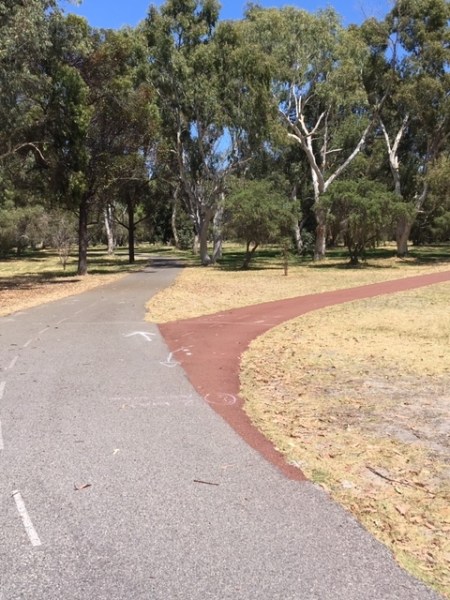
IMG_0680There is one point at which the path diverges, the path to the right taking a more meandering journey closer to the lake’s edge, whilst the one straight ahead melds through a grove of beautiful ghost gums. I always take the path to the right because I think that path is the longer route. Whilst my daughter believes the one straight ahead is the longest.
On Sunday we went riding and as usual, she was ahead of me. As she hit the ‘fork’ I wondered what she would do knowing that I prefer us to the take the path to the right. She sailed straight on. My immediate thought was, “Rascal, she knows the path to the right is longer, she is so lazy!” And then this thought entered my mind. ‘No she’s not, she simply believes that the path to the left is equally as long and is living out of that belief .’ Bam! I could see what I was being shown. She was innocently living out what she believed to be true, no extraneous thinking in there at all. (Thank goodness she was doing that and not getting caught up in anxious thinking about what I believed!)

I saw the truth of what I heard. There was no malice in her taking her path, just alignment with her thinking. If there was anything other than that, I would have seen a different behaviour from her. Instead I saw a healthy young woman on a bike, her long tanned muscular legs effortlessly pedal her away as she enjoyed her surroundings. She was living in the flow of her beliefs – as I am when I take the path to the right.

We are all doing this. Living out the thinking we believe to be true. We are all unconsciously living out our thinking. We only wake out of that dream when the thinking we are living from doesn’t serve us. Who knows whether our beliefs are true. What is true, is that our beliefs enable us to navigate life effortlessly … until they no long do.

On the one hand it can be helpful to see that we are all living out of a set of made up beliefs. The deeper ‘gem’ in this anecdote however was the moment when a fresh thought came to me about what was really going on when my daughter stayed true to her ‘path’. Hold our thinking about others (and life) lightly and we maintain a connection to a deeper source of thought that in the moment supports us to transcend our beliefs and avoid some of the problems that occur when we hold tightly on to them. At the core of all conflict is at least one belief that we assume to be true and a disregard for the wisdom that surfaces to save us  – because I know it does.

Love

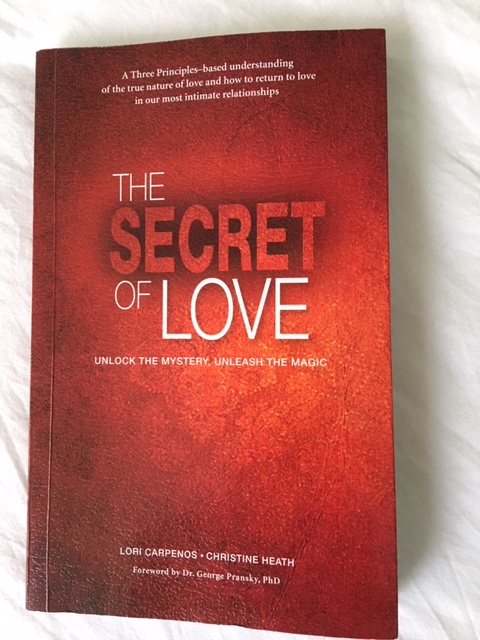
LoveDuring the week, I read ‘The Secret of Love’ by Lori Carpenos and Christine Heath. It weaves wisdom, stories of love and behaviours that can interfere with it.

A few very poignant understandings stood out.

There is only one ‘truth’ and that is that you are the thinker of your life. Every thought is like a dot appearing out of nothing. Sometimes they are created out of our natural state and sometimes they are created from our memory (learned). All of them activate neurological pathways and are experienced in the body and mind. Our perfect makeup brings thoughts alive. The fact that we are the thinker is the only truth, even though the content of our thinking can appear and feel true.

We are always (and only) in a relationship with our own thinking. Our thoughts are the medium through which we experience the external world. Our thoughts create ‘molecules of emotion’ (Dr Candace Pert) which we physically experience. Create negative thoughts and we will experience those, choose positive ones and we will experience those. Nothing outside us creates our personal feelings, although there are many, many low feeling behaviours and events now occurring in the world.

Everyone is thinking different thoughts, so everyone is having a different experience of circumstances, even the same ones. You cannot eradicate differences in any relationship.

When in relationship with another it is your thinking about differences that makes the difference in the quality of your relationship. All differences can be seen for what they are – innocent expressions of the thinking we are entertaining. Decide what differences you can live with and ones that you can’t. It is possible to love another and decide not to live or be with them.

When looking for an experience of love, whether on your own or with another, you are looking for a beautiful feeling, in yourself, and/or someone who wants to share that – above everything else. You are looking for someone who is willing to explore what’s possible when we drop negative thinking and interact only when reconnected with thought from our natural state.

Love is the natural state of Thought. Drop the dots of negative thinking and experience the warm feeling, the spontaneous eruptions of gratefulness and the wisdom that resides in the natural state of Love. Love is and can be experienced regardless of our external circumstances.

Falling in love, or falling out of it, are both an internal process of falling in the stream of thought called Love or entertaining negative thoughts that make their cheeky appearance and falling out of Love. Imagine sitting on a jetty, basking in the warm sunlight, luxuriating in the feeling on your skin and soul. A strong thought emerges to jump in to the murky water below and because you know nothing different, you follow that thought. Your mind panics, thoughts run wild and you cannot navigate the dark depths. You see a ladder beside the jetty and climb out. You resume your place on the jetty and begin to warm up again. In hindsight, you wonder why you followed that thought in the first place.