Focus Makes a Difference to Fulfilment

Decades ago, I was in a relationship that reflected the cycles associated with intimate partner abuse. It was crazymaking. I read every book available and sought help from numerous professionals. Endless seeking of information got in the way of doing what was needed. Leaving. My confusion was in my head. In my being I knew that what was being said and done wasn’t loving. That simplicity was all I truly needed. The rest was unnecessary complexity.

I see those same internal psychological dynamics operating in client presentations. People say they want something, but instead of taking action to make that happen, they get lost in a sea of thought and information from youtube channels, Instagram, internet sites, other people’s comments, professionals and self help books. Instead of information informing personal experience so that we can take action more confidently, for many its endless elaboration leads nowhere and action is stymied. The simplicity is that if something doesn’t feel right, then something in it isn’t. Trust that.
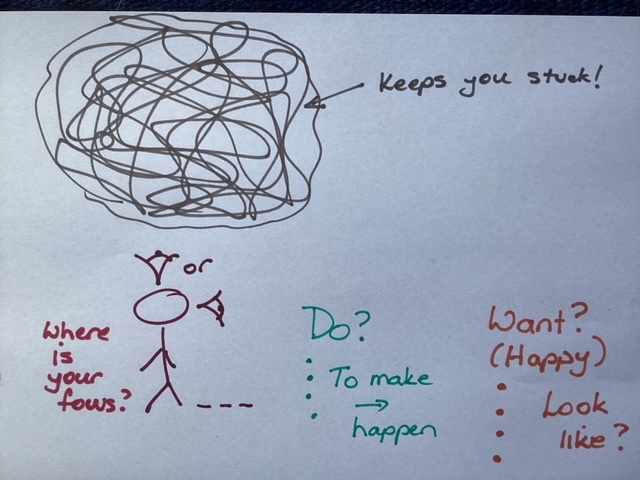
I often use this graphic in my consultations to reflect the internal dynamics of what happens. If we get out of our heads, logic usually informs what needs to be done. Maybe that is leaving a relationship, changing a job, moving someone out, getting on with studies, letting go of someone. Instead of working with the logic of what we know however, many people flip into their heads, rummaging through the various information they have read, what others will think, why they can’t do something, etc. etc. No one ever succeeded in life via that route. They succeed by getting on with things, even if it is new, they haven’t done it before and they are a bit afraid. Courage outweighs unfamiliarity. Because that is how human beings navigate the ‘new’, the ‘unexpected’, the ‘needed’. They get on with it, maybe not perfectly, maybe not even successfully, but they focus on what needs doing and do it.

Just as how we read has changed with the introduction of screen based print and entertainment, so too has how we solve problems. In reading, our automatic (learned to perfection) habit used to be deep attention, neural processing moving from left to right. Now, our automatic (learned to perfection) habit is to quickly scan haphazardly moving our eyes to differing locations, extracting info bytes and departing 3 minutes later. For many, deep reading takes more effort than it used to. With an exponential growth in information, our automatic problem solving skills have also changed. Once, we would have listened to our internal logic about matters and acted. Now we automatically search for the next information source endlessly talking, gathering (info bytes), watching …. but not moving. Our internal logic and wisdom is drowned out by the noise occupying our minds. We are stuck.

Journalling can be very effective in reconnecting with internal logic and taking practical steps. The first question is what do you want? What would your life look like if you had it? What would you have to learn to make it happen? What would you have to give up? Be specific. Give yourself permission to be honest and don’t get distracted by thoughts that critique what surfaces. Trust the train of thought that surfaces. You are not committing. You are just exploring.

Next, list all that you would have to do to make what you want happen? Again don’t get caught up in censoring your capacities and abilities. How do you feel about what you have written? Is trusting yourself and doing what’s right for you a possibility? Write into the apprehension, you may find it doesn’t have a leg to stand on.

When faced with a challenge are you automatically deviating into your head and rattling around in there instead of taking one small step? Because that’s all living is about. Small steps. Taking them one step at a time. Just like a baby learning to walk – thank goodness they can’t read before the task of walking! One step. Learn. Modify. Next step.

Beliefs Have A ‘Use By’ Date

At the time of writing this post, it is Australia Day. In years gone by, cars could be seen laden with Australian flags; dwellings acquired flagpoles; t-shirts were emblazoned with red, white and blue; and crowd faces looked like the set of Braveheart movie. Festivals were created, bands played, people drank (a lot) and fireworks lit up the sky.

Not so this year. Not one car with a flag sighted locally. Not one painted face. Much less merchandise. Australia Day celebrations silenced.

Not too long ago, voices of dissent to our entrenched interpretation of the day could be heard and different festivals emerged – ones grounded in truth telling about the invasion that usurped the traditional cultures and roles of our indigenous peoples. It soon became clear that the thinking and beliefs that framed our behaviours on 26 January had reached their ‘use by’ date. They no longer served the nation we wish to be.

The same process of change occurs in all of us – if we pay attention. Just as the beliefs underpinning Australia Day were a ‘narrow slice’ on the bigger picture, so too are the beliefs we create in our formative years about ourselves, our potentials, our abilities, our values …. the list goes on. They serve us for a while, but with time, discontent niggles within – a more mature voice wishes to be heard. If we pay attention, change can be peaceful. If not, the limits of our beliefs break and an eruption occurs. Relationships become untenable, health problems erupt, work loses its pizzazz, or we don’t like what we see in the mirror. The tiny, narrow, slivers of understanding we formed in times long gone by about the amazing power of life pulsating through everything, including ourselves, are revealed for the schtick they are.

Australian’s are embracing a different, fuller, more accurate perspective on their national day. Not everyone at the same time, but it is happening. The same occurs with our understanding of ourselves. If we slow down and listen to the niggles, exploring their content, accuracy and relevance to our current contexts, we can wake up to the expiry of the ‘use by’ date of the beliefs that drive us behind the scenes, and be open to what comes next. For change comes from within. The new thoughts that are emerging for our celebrations of this nation come from within individuals, and like a ripple effect, increasingly resonate with those who are open to listening. Deep within, we are all ‘truth seekers’ and in our own lives, the voice of fresh truth also resonates – if we listen.

Change is wired in to the flow of life, including through ourselves. Fresh thought in the form of impulses or words powers every tendril of innovation, creativity and evolution. Downfalls occur when that ‘nudge’ is ignored.

Have you listened to the niggles in the back of your mind? Do you give yourself permission to sit down and explore them through a journal? What fears get in the way? What unfounded fears about your Self sit below them? What changes would you be liberated to embrace and manifest if, like a 2021 bottle of sweet chilli sauce, you threw your beliefs that have passed their expiry date in the bin!

Releasing Resentment

It was one of those nights in which sleep eluded me. My mind was fixated on a conversation that had occurred the day prior and couldn’t let go of the perspective it had taken.

On rising the next morning, I sat with my journal and wrote. Once again, I was blessed with its fruit.

My writing revealed my resentment at someone’s inability to take a stand. Inability is the key word, for they really were unable – but my mind had simply ignored that fact and instead clung on to the incorrect view that the person could take a stand, and should. My ill founded thinking was the cause of my resentment, not the person – but it took my writing to see that.

I wrote about their early life, of the experiences they had endured, and of the mechanisms they had creatively developed to survive. Taking a stand was not one of them. Taking a stand incurred violence. So instead, they learned to hide, and as an adult, to keep ‘messy’ people and ‘messy’ life out of their lives. Whilst voicing strident opinions with an intensity that reflected their fear came easy, acting on them did not.

It made sense. Our early years are the context in which we learn to think so that we survive and stay connected with people. Unconsciously, it becomes our ‘manual’ for navigating life. ‘Don’t speak up’, ‘don’t annoy anyone’, ‘work hard’, ‘don’t try’ and endless others become ‘chapters’ that steer our engagement with life from behind the scenes.

As my writing revealed this person’s history, compassion rippled through my body. I understood how difficult it is to break out of a lifetime of unconscious psychological habit, something that can only occur if we trust the core of who we are. None of this person’s early experiences inserted that ‘chapter’ into their personal ‘manual’. My resentment was ill founded.

If you are feeling resentful towards another and wish to move on, I invite you to sit down and write about the situation on which you have fixated. Articulate on the page what you think the person should have done. Be honest with your recount, because it is this thinking that is getting in the way. Then reflect upon what that person would have needed to know about themselves, and the experiences they would have needed in life, to become the sort of person you expect. Then write about the early life they had and how they learned to survive in that context. It’s no good resenting someone for actions and behaviours they have no idea how to execute or that they are not capable or free to do so. Like canaries in an open cage, rarely is anyone completely psychologically free to live congruent with the active intelligence that animates us. We all possess our own straightjackets.

The Nature of Thoughts

If plants possessed attention, where have they pointed it? Is it the same for human beings?

The human mind is a thought generator. Turn it to how much you dislike someone or something and it will generate thoughts aligned with that direction. Turn it to something you are passionate about and it will generate thought aligned with that direction. Unlike plants, we have the free will to turn our attention in whatever direction we choose. To possibility and something fresh … or to the ground hog day of habitual ways of thinking, feeling, talking and acting.

In preparation for a journalling circle recently, I initially turned my attention to memory – to what I knew and how it would structure a probable outcome. But in the back of my mind, an image from a journalling group several years ago, kept ‘knocking’. I wanted the lightness and feeling of that moment in our meeting.

So, I put aside what I thought I should do, and sat with the feeling. The thought came to pick up a book about journalling and browse. Again, my intellect wanted to categorise into useful and not useful, but instead I let the feeling guide me. I resisted the prompt that resonated. ‘List the milestones in your life, add a few details and write about one.’ My head said it was too banal, but I chose to trust the nudge, and wrote up my preparation.

Wow, what a rich time we had. No one writing yielded the boring writing I had anticipated. Everyone accessed something fresh and new.

‘I’m the driving force of my direction.’

‘Living smaller doesn’t mean living smaller.’

‘Whatever is to come, I know I will be okay.’

‘I can choose to enjoy the time before me.’

In the myriad of the words we wrote, a sentence or a phrase in each piece ‘grabbed’ us. The human mind is a thought generator, but not all thoughts are equal. In the midst, deeper truths can be felt. Maybe there is more in common in the Nature that animates us and plants than we think.

Journalling for the ‘Gifts’ in Christmas

What an awful Christmas. I am grateful for its ‘wake up call’.

The impact of people disconnected from the essence of the ‘spirit of giving’; the unexpected death of a close friend; fast failing terminal health in another; and untethered expressions of nastiness, all ‘woke’ in my consciousness over Christmas. Taking time to write and reflect by my local lake revealed blind spots in my thinking, peeled away layers that had reached their ‘use by’ date, and deepened fresh awareness of what was needed to move forward.

A slight breeze rippled the lake whilst walkers and joggers chatted and panted. In the muted sound and light of early morning, I recorded the content of my busy and discombobulated mind.

The spirit of giving whether in the form of a small gift, effort, or time, is important to me. In the lead up to Christmas, my daughter and I took great enjoyment in baking, making and wrapping. Friends and family responded in kind, either in appreciation or with another small gift. But a few significant recipients didn’t. It wasn’t the first time. Free flow writing revealed chasms in values I had not acknowledged, and opened up a pause in which to consider ongoing investment in connection or not. It was a significant decision, and I wrote over several days until my words settled. ‘Shallowness’ that does not sustain and nourish the human spirit is now less in my life and my time is free to invest in relationships more aligned with who I am.

Writing about the unexpected death of a close mate revealed a mirage we all played into, denying us time to say what mattered. We assumed that because doctors were ‘monitoring the situation’, we always had tomorrow to look forward to and that the ‘work of maintaining health’ would take a break over Christmas until services returned from holidays. But Christmas isn’t a pause button. Unanswered phone calls can’t now be answered tomorrow – he’s gone. Writing revealed the need for greater courage and authentic conversation with those not doing so well healthwise, regardless of health professional involvement.

Nasty communication also appeared in the array of human interactions over the festive period. Writing about the personal impact revealed (again) how easily very old learning is activated.  Once upon a time it allowed me to survive a tough environment and to keep living into the future. But I am no longer a child and nor am I in school. We all age and context changes. As that neural wiring calmed, my writing revealed clarity about the people involved now. I didn’t have to engage. Their use of nastiness revealed their psychological functioning. I was not the one to help. Writing about and through that emotional pattern reminded me to be more discerning in who I trust and the depths of care I invest. There are people we can be intimate with, others we socialise with, others who we negotiate in business, and others we walk by.

My pen recorded it all in my journal.

When we are busy navigating life and reaping the efficiency rewards of all the learning we have internalised to automaticity, we can miss valuable information in the present moment. Human learning mechanisms are great for learning to drive a car, but less reliable for more complex matters of living. Slowing down, and prioritising time to journal can reveal understanding in the present moment not recorded in the wiring of our old learning.

Post any intense emotional experience, I invite you to write to the following prompts:

  • Name and describe what you have been through. Be honest. No two people have the same experience. Our thoughts are the ‘ingredients’ of our unique experience. They are the amazing culmination in evolution that allows us to navigate life with efficiency. Identifying and naming the thoughts contributing to experience reveals the limitations of past learning, and nudges questions that take us beyond what has become unconscious (learned to automaticity).
  • Name your expectations (also thoughts). What were your expectations and what did the experience reveal to you about the true nature of life, including the people in it?
  • How do you feel about the match/mismatch between the reality and your expectations?
  • What implications does your deeper, more conscious, understanding of reality have for how you live in the future? What changes would you like to make? Do you have the courage?

Human Magnificence

Piney Lakes Reserve, Murdoch, Western Australia.

At one point during the outdoor journalling workshop I conducted last Sunday, we explored the different nuances of thought that cross our minds, in particular drawing attention to the ones that ‘click’ and feel right. One participant described them as ‘karmic’, i.e. they come with a feeling of ‘already known’ – as if they were part of us.

A magnificent tree stood nearby. I often use trees as analogies in my counselling work. The grandeur of this tree originated in a small seed. Life flowing through that seed, enabled all of it to unfold. It is the same with human beings except that we are endowed with unique capabilities that provide additional powers of survival.

The first of these capabilities is Thought. It flows through us manifesting as language and images and accompanied by bodily experience. We can know the quality of thought in our mind by the feeling we are experiencing. The health of a tree is dependent on the ground and environment in which it lands. With the right mixture of nutrients, light, water, air, etc., the alchemy that comes from the interaction between the life force, the DNA of the seed and its surrounds brings about its healthiest possible flourishing. The life force can only do the best with what it has. Poor DNA, poor environment or disease, and the resultant tree is a poorer version of its potential.

Thought capability enables human beings to rise above their environments, external and internal. Thought is like the artist’s brushstroke. We can learn to use it better. We can become aware of its neverending availability, of which thoughts we ‘velcro’ and which ones we ‘teflon’, of how it creates our experiences, of the continuum it roams, of which thoughts hinder and which ones help. Thoughts flow to us, through us and beyond us, all the time. Deliberate effort is not required to have a thought. We don’t have to know the answer to something before an answer comes. Thought will always offer something up that is unique to us and the moment. We are always following it – unconsciously for the most part. Thought is behind every feeling we have and every action we take.

We can’t be aware of the thoughts crossing our mind without the capability of Consciousness. We can be aware of the thinking we are doing in the moment, we can be conscious of whether we are ‘in’ our heads (and disconnected from the present moment), or fully engaged in what is before us. We can know what our body is experiencing in the moment and therefore what is ‘tainting’ our minds. Consciousness is a huge gift. Animals do not have the breadth and depth of awareness that human beings possess. They can’t independently ‘send’ their awareness back and forth in time, or turn it inwards, or outwards into the experience of another (without getting caught up in the other’s experience). We can direct our attention and what we are conscious of in the moment, at will.

Thankfully, Free Will is also wired into human beings. I suspect it is the natural interaction between consciousness and thought, but in the early stages of changing cognitive habits, we can deliberately make choices, even if they feel uncomfortable and ‘alien’. We have the ability to be conscious of the thoughts on our mind and their effects on our bodies and lives. We also have the ability to choose which thoughts to stay engaged with, which ones to pass us by, which ones to act on, which ones to not. We are not designed to be passive consumers of our thoughts (although systems would have us believe so). We have agency. Wake up (become conscious), notice and choose.

A deeper capability wired into human evolution is intelligence, or Wisdom. I am not referring to that which is learned via instruction or formal education. I am referring to a quality of thought that appears in between our habitual ‘busyness’, worry, overhwelm, anger, low moods, etc. These thoughts are new, fresh, and helpful. They come with a feeling of ‘stability’ and ‘rightness’ to them. We experience them when something forgotten is remembered, when we say something deeper and previously unexpressed, and when we have an insight or ‘aha’ moment. They have clarity. They are the quiet voice that says its time to move on from a job or relationship, and the same quiet voice that keeps circling, whispering directions and projects that beckon.

When we don’t heed the quiet whisperings of Wisdom, or celebrate its insights, or turn towards moments in which something ‘touches’ us and mine the ‘diamonds’ of wisdom that sit below, we become like the trees rooted in saline soil. We wither. Evolution endowed human beings with unique capabilities needed to survive and flourish through adversity, both personal and collective. Journalling, guided by an understanding of the unique capabilities built into our evolutionary endowment, can provide a pathway for making what is unconscious, conscious, and living more in alignment with what we need to successfully navigate an increasingly pressing game of life. It doesn’t make sense that such a sophisticated animal such as the human being has evolved without the capabilities needed to further evolution. We are not dinosaurs, victim to whatever befalls us. Evolution has ensured we are a long way ahead of the capabilities they were endowed with. Wake up to your unique capabilities and ‘milk’ them.

Disentangling

In the world of personal growth, there are ‘many roads to Rome’. My particular pathway to liberation of the self and greater authenticity is journalling. The practice supported me to successfully navigate the dismantling of an emotionally unhealthy relationship and create a wonderful life. It is where I go to process parenting issues or questions about the direction of my work. It is also where I go to record insights as they come, observations about how our inner world works, and moments of intense gratefulness for the gift of being alive.

Over the years I have learned a lot from journalling. I have learned which thoughts to follow, and which ones to allow to float on by – another one always enters. I have learned to trust the feelings of my body and what they are telling me. I have learned to sense whether I am speaking from memory irrelevant to the moment or speaking from deeper wisdom within. I have learned to respect and trust my intelligence. I have learned that tension reflects a person’s ability to hear or not. I have learned to listen for conversations open to engagement and to speak when moved. I have also learned to not speak when learned habits from the past dictate that I should. I have learned to create healthy boundaries and to stay out of other people’s psychological entanglements unless they ask for help. I have learned to trust life instead of fear it.

When I work with clients I take note of the psychological entanglements some people get caught up in when speaking. Conversation patterns generated in families of origin, reflective of class, or created in response to trauma, are revealed. Some people have unconsciously learned to avoid the knowledge and wisdom accumulated through experience. These people have a ‘teflon’ relationship to their inner truth and the way they answer questions reveals this. Whilst others consciously reflect and speak from the accumulated knowledge and wisdom within. When someone speaks ‘with substance’ I can hear and feel the truth of it. When someone responds with a ‘teflon’ response it is as if they begin to move in the direction of what they know but at the last minute slide away. Somewhere they have learned to be afraid of what they know.

‘What activities do you like to do that make you feel good?’ -|-> (Authentic) ‘Snorkelling, I love the feeling of mystery when I am underwater and I never know what fish will be around on the day.’ .|C> (Teflon) ‘I don’t know, I don’t enjoy anything.’ On attempting a different pathway in, a childhood memory comes to mind which then leads to a surprising recall of something they enjoy doing as an adult.

‘What do you want to do about the marriage?’ -|-> (Authentic) ‘I’m done. I can’t do this anymore. It’s time to move forward.’ .|C> (Teflon) ‘He says he wants to change and make the marriage work but then he says its my fault because I never agree to what he wants to do.’ In this response, a speaker’s attention has been diverted to the words of their partner instead of their own.

‘Wow, you must be feeling really sad.’ -|-> (Authentic) ‘Yes, she has been my constant companion for over 20 years. I will miss her a lot.’ .|C> (Teflon) ‘No, I will be fine.’ As tears are swiped away.

Each of these ‘teflon’ responses reflects the activity of thoughts learned in the past entangling and contaminating present moment authenticity, wisdom and experience. In any moment we are either experiencing the truest expression of ourselves or it is contaminated by something we have learned, in the past, to think.

Many women have been conditioned to think of themselves as not the decision makers, as not intelligent and therefore not the person in charge, and as caring for things that are unimportant to society. All of this is not true. Society, families, relationships, and selves, need the voices from the depths of our truth. Journalling is one way to familiarise ourselves with the timbre and feel of that voice and to know when it has become entangled with beliefs and thoughts created in the past and innocently carried forward contaminating the present moment experience.

If you are interested in learning and experiencing how journalling can support you to become aware of the deeper, secure self that exists within everyone so that you can be in the world with greater confidence and faith in yourself, I am running a series of introductory workshops, in person and on line, over the coming months. All workshops will be posted on my facebook page https://www.facebook.com/GeorginaMavor.