When people come into counselling, I suspect they think that if we just talk about everything, that in some miraculous way, it ‘fixes up’ the content of whatever is going on. The problem is there is SOOOO MUCH going on.
People not liking what we have done, people wanting more from us, unhealthy workplaces, poor relationships, addictions, people dying, sickness, struggling children … the list is endless. All of these issues benefit from a bigger perspective conversation. But the amount of time this would take is unreasonable, and new ‘problems’ surface along the way.
As part of her current More Signal, Less Noise 5 Day training Barbara Patterson presented a simple understanding of how everyone perceives in the moment – including ourselves. We are either interpreting life (and ourselves) from clarity, or we are interpreting from an agitated internal state and our thinking distorts reality. It bends it out of shape.
See the actions of a family member in a clear state and we see their acts of kindness and care. See it from an agitated state, and we distort our attention and thinking, catastrophising one small detail. See our own agitated internal state from clarity and we experience compassion. See the same internal state from agitation and we distort our experience into shame. Sensing whether ourselves and/or others have a calm internal climate or an agitated one, makes all the difference in knowing whether we, or others, are seeing clearly, or whether thinking is distorting reality.
Knowing this simple understanding provides flexibility in response as against groundhog day of repeated neural firing. If I know I am perceiving from an agitated internal climate, I can choose to sit still, breathe, redirect my attention, listen, etc. If I can see that the other person is expressing from an internal agitated state, I can choose to calm them down, distract, or I can walk away.
Everything going on in a person’s life can’t be talked through and ‘settled’ into place. But everyone can discern whether they and/or others are seeing clearly, or are innocently distorting reality. Familiarising ourselves with this simple ‘tool of awareness’ then opens a portal to forming a conscious relationship with the Me behind all the distorted thinking. The Me that nudges, realises, insights and knows – even when an internal tsunami is underway.
What an awful Christmas. I am grateful for its ‘wake up call’.
The impact of people disconnected from the essence of the ‘spirit of giving’; the unexpected death of a close friend; fast failing terminal health in another; and untethered expressions of nastiness, all ‘woke’ in my consciousness over Christmas. Taking time to write and reflect by my local lake revealed blind spots in my thinking, peeled away layers that had reached their ‘use by’ date, and deepened fresh awareness of what was needed to move forward.
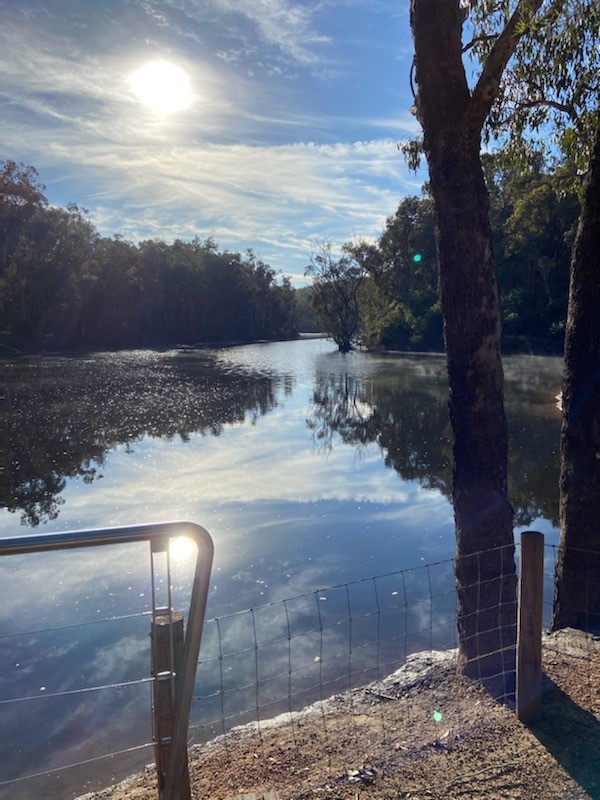
A slight breeze rippled the lake whilst walkers and joggers chatted and panted. In the muted sound and light of early morning, I recorded the content of my busy and discombobulated mind.
The spirit of giving whether in the form of a small gift, effort, or time, is important to me. In the lead up to Christmas, my daughter and I took great enjoyment in baking, making and wrapping. Friends and family responded in kind, either in appreciation or with another small gift. But a few significant recipients didn’t. It wasn’t the first time. Free flow writing revealed chasms in values I had not acknowledged, and opened up a pause in which to consider ongoing investment in connection or not. It was a significant decision, and I wrote over several days until my words settled. ‘Shallowness’ that does not sustain and nourish the human spirit is now less in my life and my time is free to invest in relationships more aligned with who I am.
Writing about the unexpected death of a close mate revealed a mirage we all played into, denying us time to say what mattered. We assumed that because doctors were ‘monitoring the situation’, we always had tomorrow to look forward to and that the ‘work of maintaining health’ would take a break over Christmas until services returned from holidays. But Christmas isn’t a pause button. Unanswered phone calls can’t now be answered tomorrow – he’s gone. Writing revealed the need for greater courage and authentic conversation with those not doing so well healthwise, regardless of health professional involvement.
Nasty communication also appeared in the array of human interactions over the festive period. Writing about the personal impact revealed (again) how easily very old learning is activated. Once upon a time it allowed me to survive a tough environment and to keep living into the future. But I am no longer a child and nor am I in school. We all age and context changes. As that neural wiring calmed, my writing revealed clarity about the people involved now. I didn’t have to engage. Their use of nastiness revealed their psychological functioning. I was not the one to help. Writing about and through that emotional pattern reminded me to be more discerning in who I trust and the depths of care I invest. There are people we can be intimate with, others we socialise with, others who we negotiate in business, and others we walk by.
My pen recorded it all in my journal.
When we are busy navigating life and reaping the efficiency rewards of all the learning we have internalised to automaticity, we can miss valuable information in the present moment. Human learning mechanisms are great for learning to drive a car, but less reliable for more complex matters of living. Slowing down, and prioritising time to journal can reveal understanding in the present moment not recorded in the wiring of our old learning.
Post any intense emotional experience, I invite you to write to the following prompts:
Name and describe what you have been through. Be honest. No two people have the same experience. Our thoughts are the ‘ingredients’ of our unique experience. They are the amazing culmination in evolution that allows us to navigate life with efficiency. Identifying and naming the thoughts contributing to experience reveals the limitations of past learning, and nudges questions that take us beyond what has become unconscious (learned to automaticity).
Name your expectations (also thoughts). What were your expectations and what did the experience reveal to you about the true nature of life, including the people in it?
How do you feel about the match/mismatch between the reality and your expectations?
What implications does your deeper, more conscious, understanding of reality have for how you live in the future? What changes would you like to make? Do you have the courage?
I’m at a turning point in my life and whilst I’d like to only make ‘moves’ that are comfortable and are assured of a positive outcome, sometimes we just have to jump into experience and see where it leads.
Yesterday, I returned from a weekend away camping – on my own. A new experience, not necessitated by retirement, but rather brought about by the rounding out of 18 years ‘late in life’ responsibility for single parenting. Intense active involvement is no longer required. What to do with all the free time I now have in a personal life bereft of satisfying social activity?
Start with the activities I do like and go from there. Being in nature, camping, journalling, ‘barnstorming’ (without the plane) down neverending unknown West Australian roads that pass through towns marked only with a building or two. I booked a favourite camping site, loaded up the car, opened the door for my Red Cloud Kelpie and drove off.
The camping spot is just over an hour from Perth. Located in forest country along the escarpment running down the coast, it experiences more rain than its neighbouring regions. We woke on Sunday to thunder and my dog whimpered under the sleeping bag whilst I relished the tinkle of raindrops on the swag roof.
After the storm passed, and breakfast was done, we ventured to a section of the river I had identified the night before as an alluring swimspot. With no one else around we both luxuriated in quiet isolation. This exquisite moment revealed itself as the highlight of the trip.
What to do next? I had already written many pages in my journal, begun reading a new novel and made a start on this blog piece. With limited external ‘drivers’ to snag my mind, it had immersed itself in trains of thought about the folly of coming away, how I could be at home (but bored with what is becoming an entrenched daily routine), and my lack of social networks. Giving in to my lowered mood and returning home would only provide more of what I already knew. That didn’t feel right so I waited, and other, more enticing ideas arrived.
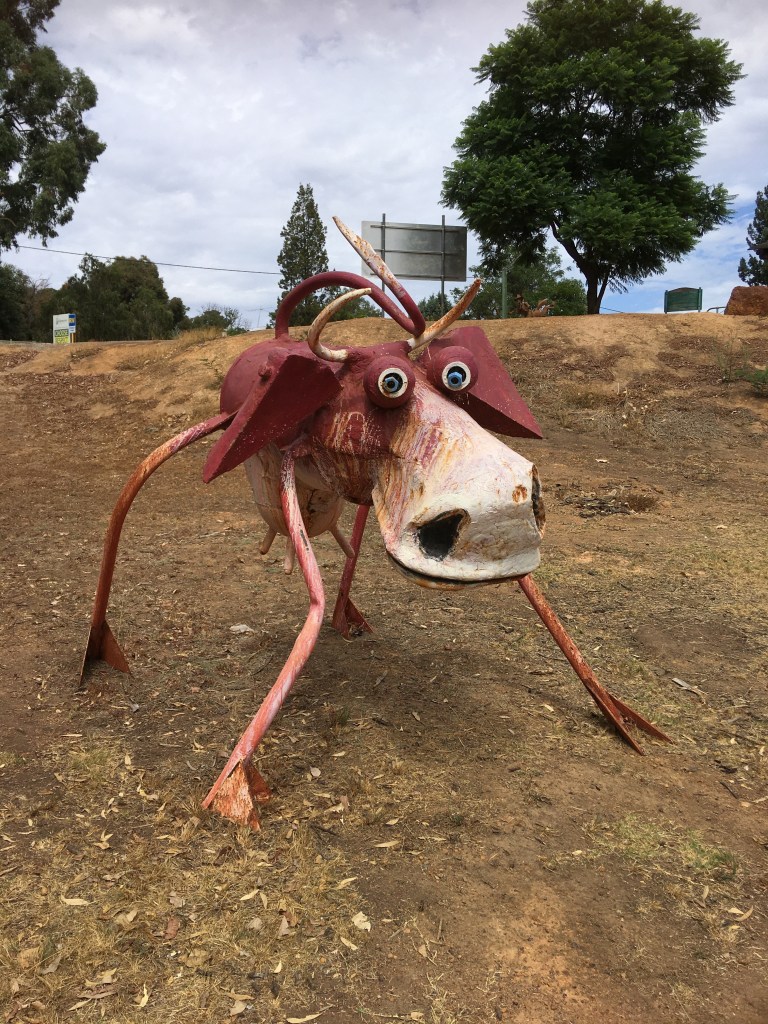
With the campsite packed up, I hit the bitumen road and drove an hour inland to the next town – Boddington. The townsfolk seemed to enjoy building local sculptures out of defunct farm equipment. It was hotter than our overnight stay and Shire signs forbade swimming in the river. Whilst the shady campsites were enticing, no swimming mitigated against staying. My dog, however, ran through the shallow edges of the riverbank. It was only as we were about to get into the car that I noticed her black, oily, smelly feet. She could not take them into the car. Ten minutes later I found a tap and spent 5 minutes washing her four paws. My hands were black. What was in that sludge?
On the road again, we drove in a different direction, further south and inland. Sheep land. Hundreds of them standing around the edges of water holes in the middle of dry arid paddocks. I wondered how many sheep farmers lost on days when the temperature was 10 to 15 degrees harsher.
At Quindanning I took a photo of this church. The square turret seemed out of place. The pub seemed busy judging by the number of cars outside.
At Williams, I got excited about what I would find inside the ‘Williams Woolshed’. Whilst it accommodated a great looking cafe and a huge display of products like wine, oilskin products, emu skin shoes, natural health care products, local books and wool attire, I was disappointed to realise not much of it was local. Real local people, living real local lives, is what interests me. What do they create out of a dry, isolated landscape while the sheep do their thing? What does their creativity inspire? Another product from interstate or overseas held no interest for me and the op shop in the old building next door was shut. It was time to move on.
It was now mid afternoon and I had to decide whether to drive home or find another place to camp for the night. Finding another place with water nearby was looking bleak so I turned for home. Little did I realise it would take another two hours at least to get there. I also didn’t realise how tired I was. Whilst the drive was a strain, I did come across signs to places I had previously earmarked to explore. At least now I had reference points both in terms of location and travel time. I also identified a few places of interest to explore along the way.
Overall, my camping trip wasn’t as I had anticipated. Whilst there were moments I relished, it wasn’t the pleasure I yearned. I know that both my enjoyment and despondency were a reflection of state of my mind at the time. One moment I was thinking that the opportunity swim in a pristine natural pool with no one else around was bliss, and in the next I was wallowing in thoughts about how isolated or tired in body I was. The weekend was an endurance test of my mind.
One I am glad I experienced. Even though I didn’t happily enjoy every moment, giving into my low state of mind would have robbed me of what I learned about myself and my terrain, and none of that which unfolded on my return would have unfolded. My experience provided me with information about the location of places of interest. I can now plan more confidently. I learned I need to take my good camera. I also now know much more about myself. I no longer have the stamina to drive for long periods of time. I need to take that into account. And I really do need to participate in activities other people organise.
Which is why, on my return home, I booked into several group events run by one of the fb camping pages I belong to. It is time to meet new people. Taking into account my reduced driving stamina, I have chosen events that are closer to home. With more experience and familiarity I will ‘range’ further. Small steps. Incorporate what I have learned and keep going. A low state of mind is like the sludge on my dog’s feet. Wash it off and keep going, even if you have wet uncomfortable feet. Do nothing and the sludge of a low mood state of mind becomes encrusted. The possibility of experiencing different destinations diminishes. All actions lead somewhere, including the inaction in response to low states of mind. They are nothing more than sludge. Keep travelling down different roads of experience, and relish what they bring, even when uncomfortable.
At 9.00 pm, after a 10 hour day, I am doing the dishes. I notice I am feeling quite energized and alive. Other nights, I feel tired and haggard. I know my vitality level is created from the state of my mind. Open and free flowing, and my vitality levels rise. Occupied with ‘hard’ thinking and my vitality drops. Tonight, I have nothing on my mind. My attention is fully occupied by the dishes and being in my home.
I’m aware I can easily change my experience in this moment. Think differently. ‘I’m so tired. I hate always having to do this at the end of the day. And then I don’t sleep!’ Result? Feel tired and haggard. I think how funny it is that with a simple switch in thinking I change what I feel. Same activity, different thinking, different feeling (experience). I feel entertained with that thought. I reflect on the fact I don’t have a dishwasher. I think ‘dishwashers are unenvironmental’ and I feel distaste. So I don’t have a dishwasher. Everything starts with a thought.
My Red Cloud Kelpie stands at the door waiting to go outside. I think ‘she’s cute’. I caringly let her out. One minute later, she is waiting at the door to come in. I think, ‘she’s a pain in the butt’. I feel annoyed and let her in. Another moment of ‘hard’ thinking creating a harshness in feeling.
I think that tracking my thinking and feeling moment by moment is a lot of work. I feel tired. And on, and on, and on, it goes. Thinking and feeling.
At one point during the outdoor journalling workshop I conducted last Sunday, we explored the different nuances of thought that cross our minds, in particular drawing attention to the ones that ‘click’ and feel right. One participant described them as ‘karmic’, i.e. they come with a feeling of ‘already known’ – as if they were part of us.
A magnificent tree stood nearby. I often use trees as analogies in my counselling work. The grandeur of this tree originated in a small seed. Life flowing through that seed, enabled all of it to unfold. It is the same with human beings except that we are endowed with unique capabilities that provide additional powers of survival.
The first of these capabilities is Thought. It flows through us manifesting as language and images and accompanied by bodily experience. We can know the quality of thought in our mind by the feeling we are experiencing. The health of a tree is dependent on the ground and environment in which it lands. With the right mixture of nutrients, light, water, air, etc., the alchemy that comes from the interaction between the life force, the DNA of the seed and its surrounds brings about its healthiest possible flourishing. The life force can only do the best with what it has. Poor DNA, poor environment or disease, and the resultant tree is a poorer version of its potential.
Thought capability enables human beings to rise above their environments, external and internal. Thought is like the artist’s brushstroke. We can learn to use it better. We can become aware of its neverending availability, of which thoughts we ‘velcro’ and which ones we ‘teflon’, of how it creates our experiences, of the continuum it roams, of which thoughts hinder and which ones help. Thoughts flow to us, through us and beyond us, all the time. Deliberate effort is not required to have a thought. We don’t have to know the answer to something before an answer comes. Thought will always offer something up that is unique to us and the moment. We are always following it – unconsciously for the most part. Thought is behind every feeling we have and every action we take.
We can’t be aware of the thoughts crossing our mind without the capability of Consciousness. We can be aware of the thinking we are doing in the moment, we can be conscious of whether we are ‘in’ our heads (and disconnected from the present moment), or fully engaged in what is before us. We can know what our body is experiencing in the moment and therefore what is ‘tainting’ our minds. Consciousness is a huge gift. Animals do not have the breadth and depth of awareness that human beings possess. They can’t independently ‘send’ their awareness back and forth in time, or turn it inwards, or outwards into the experience of another (without getting caught up in the other’s experience). We can direct our attention and what we are conscious of in the moment, at will.
Thankfully, Free Will is also wired into human beings. I suspect it is the natural interaction between consciousness and thought, but in the early stages of changing cognitive habits, we can deliberately make choices, even if they feel uncomfortable and ‘alien’. We have the ability to be conscious of the thoughts on our mind and their effects on our bodies and lives. We also have the ability to choose which thoughts to stay engaged with, which ones to pass us by, which ones to act on, which ones to not. We are not designed to be passive consumers of our thoughts (although systems would have us believe so). We have agency. Wake up (become conscious), notice and choose.
A deeper capability wired into human evolution is intelligence, or Wisdom. I am not referring to that which is learned via instruction or formal education. I am referring to a quality of thought that appears in between our habitual ‘busyness’, worry, overhwelm, anger, low moods, etc. These thoughts are new, fresh, and helpful. They come with a feeling of ‘stability’ and ‘rightness’ to them. We experience them when something forgotten is remembered, when we say something deeper and previously unexpressed, and when we have an insight or ‘aha’ moment. They have clarity. They are the quiet voice that says its time to move on from a job or relationship, and the same quiet voice that keeps circling, whispering directions and projects that beckon.
When we don’t heed the quiet whisperings of Wisdom, or celebrate its insights, or turn towards moments in which something ‘touches’ us and mine the ‘diamonds’ of wisdom that sit below, we become like the trees rooted in saline soil. We wither. Evolution endowed human beings with unique capabilities needed to survive and flourish through adversity, both personal and collective. Journalling, guided by an understanding of the unique capabilities built into our evolutionary endowment, can provide a pathway for making what is unconscious, conscious, and living more in alignment with what we need to successfully navigate an increasingly pressing game of life. It doesn’t make sense that such a sophisticated animal such as the human being has evolved without the capabilities needed to further evolution. We are not dinosaurs, victim to whatever befalls us. Evolution has ensured we are a long way ahead of the capabilities they were endowed with. Wake up to your unique capabilities and ‘milk’ them.
No life avoids the need to change. Resistance to growing up, to deepening in relationship, to heeding the body’s needs, to leaving an abusive situation, to changing unhealthy habits, to confronting mortality, to moving on … leads to psychological and physical distress. Embrace the change needed and life unfolds afresh.
Last week, at 18, my only child gained her driver’s licence. With two fulfilling part time jobs and an expanding network of friends, her licence affords her increased freedom with which to explore and craft her adulthood. Life naturally invites her in that direction and she has accepted.
Her driver’s licence brings my intense parenting to an end. After years of supporting school and sporting commitments, a year of driving her to and from her workplaces (5 times a week), and more recently, a year of teaching her through 50 hours of driving, I now faced vast swathes of time, underdeveloped social networks and faded memories of pastimes nearly forgotten.
Some months ago, I could see this transition looming on the horizon. Either I could sit at home lamenting the empty nest, or I could choose to move forward with me at the centre of my attention. This I wasn’t familiar with. My energy levels pulled me to the sofa, a future I didn’t want. If I was going to experience a better quality of life than years in front of the TV, I needed to craft it from within, listening for what fit and to slowly take the journey.
Whilst my daughter was growing up, I enjoyed camping and music festivals. With each new adventure, I learned something about myself. I learned I needed comfort when camping – managing insects and heat well, being close to water to swim in, lying on a comfortable mattress, all make a difference. I also learned I needed to reduce my responsibilities when camping – leave the dogs (and my parents) home. I learned I needed to reduce the amount of work required of me – ‘air pole’ tents are great, camp kitchens suffice and no one needs that amount of ‘stuff’. I also learned I don’t like large music festivals, and smaller ones that are safe for children allow single parents to enjoy a rare moment to relax from vigilance.
These two activities, together with a commitment to regularly connect with neglected friends and a resurrection of journalling workshop emerged as the entrypoint for crafting my ‘later life’ years. I now check in with friends at least once a fortnight and have booked two night camping trips once a month.
This weekend gone by, I camped at Herron Point, just south of Mandurah, Western Australia. It is located on the ‘estuary’ and is well known for ‘crabbing’. The campsite was very rustic. West Australian grey sand in the campgrounds, with pristine white sand on the estuary foreshore. Thankfully there were many shaded trees for cool comfort as a warm easterly wind blew most of the time. Whilst some children swam in the estuary, there are signs suggesting people refrain from doing so after floods as there are elevated levels of nutrients in the water. I erred on the side of caution and simply waded to cool down. ‘Crabbing’ adults wore rubber trousers.
Setting up my new swag, table, chair and cooking area took 20 minutes. Time to explore before a friend arrived later that evening. Children and their fathers carried nets and buckets whilst searching for crabs, whilst mums sat on chairs in shallow water. The sculpted shoreline ran in bays with an occasional long stretch. Dried sea plant life lay in clumps along the beach and gnarly dead trees, roots exposed, provided interesting contrasts against the skyline. Pelicans abounded and at times could be seen in large groups feeding from the water below. Red hot orange skylines ended each day, whilst pastel pink, blue and mauves welcomed them in. With so much activity, the campsite was asleep not long after 9 pm – but was in full crabbing mode again at 6.30 am. By 10 am Sunday, ours was the only campsite remaining.
My dog had eaten all her dry food the night before, so I suggested we go into Mandurah for a quick shop. On our return, I recalled a family holiday on the river near Yunderup when I was young and on a whim we decided to explore. It was winter when my parents and grandparents rented a weatherboard shack from a wharfie mate of my father’s. Campbeds in a sleepout, rough wooden floors, a wood stove, tea tree bushland and a jetty on the river made it a rare magical time. I remember the men fishing for cobbler in the gloomy black water of night, hurricane lamp burning nearby. Those jetties are still there. So are some of the more modern shacks. But mansions have also shot up, as have white picket fences, and a large number of river craft. The fish are few.
We walked along a river path, my red cloud kelpie exploring the water’s edge and occasionally falling in. The placement of chairs, and gates, and signs, telling the story of how people now lived their lives. I enjoyed the juxtaposition of carefree, communal living with displays of more modern single minded ownership.
This was my first foray in crafting an independent life that I hope will eventually be filled with activities and people and places I really enjoy. It took time to feel comfortable with my start. I learned it is important to follow the impulse to explore, to write, to read, to sit and to chat. I learned I could organise new experiences that were outside my comfort zone but not so far out that I wouldn’t begin. I learned that slowing down and listening for what feels right for me supports a great time. I learned that I might quite like exploring country towns and the people who story them. I learned that if I make a start and don’t shut the endless possibility of my mind down with judgements and criticisms, new ideas and thoughts of ‘what next’ emerge. I learned that my choice of which thoughts to follow determines the quality of the life I lead. Which do you choose?
The title of this blog post came from the mouth of a young person who had come to see me because of the dangerous nature of the thinking that had crossed their mind.
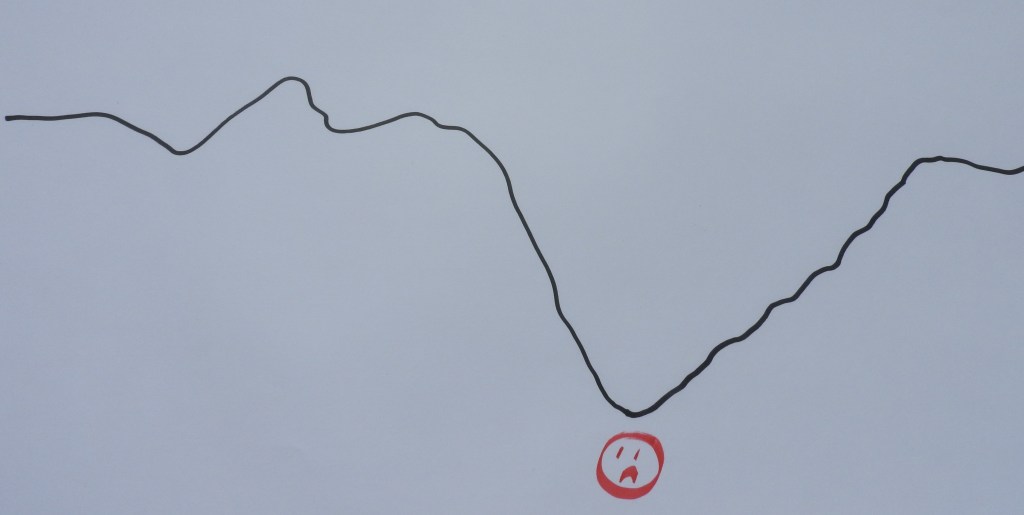
I drew the line below on the whiteboard in my office.
I often draw a line to show people that we are all following our thinking all day long. And as the quality of our thinking fluctuates so does the feeling we experience. Think harried thoughts about all the tasks that need doing and you will feel harried. Think angry thoughts and you will feel angry. Think grateful thoughts and you will feel grateful. Be open to doing whatever comes to mind and you will feel calm and relaxed. In the particular instance above, the young person had been going about their day when something occurred and their thinking derailed down a dark alley.
Interestingly, they didn’t act on that thinking – otherwise they wouldn’t be in my office.
I commented on this and asked what thinking came into their mind after the dark thoughts.
‘That ‘that thinking’ wouldn’t end well.’ Yep, that was true.
‘That I needed to get myself out of there.’ Made sense.
‘That I needed to speak to someone.’ Wise.
‘Where did all this thinking come from,’ I asked (pointing to the rising line after the unhappy face). To which they replied with the title of this blog post.
A ‘smarter part of us’, naturally surfacing, no effort, no struggle to change our thinking, just spontaneously erupting of its own accord to lead us back to a clearer, calmer state of mind. Everyone has it. All the young people who come in to my office concerned about self harming or suicide have it. So do the adults who know they are struggling but sense there is more. Most of us don’t notice it. Some listen to it, some don’t. How have we got to this point in our evolution in which we are largely ignorant of the workings of our ‘wired in’ resiliency and mental health?
Do we notice the relationship between our thoughts and our feelings? Can we see that our thinking is the mediator of all experience, whether it be of a rainy day or of scary thinking crossing our mind? Do we notice that thinking fluctuates? Do we notice the powerful change brought about by a split second shift in our thinking that arrived without deliberately conjuring it up? How does that happen? Do we notice the impact of insights on our habitual trains of thought? Do we wonder where shifts in thinking come from? Psychology tells us that once we have started along a negative thinking path it tends to keep going in the same direction. What it fails to remark upon and get curious about is the fact that our innate mental health never fails to offer up a thought that will bring us back to our senses – if we choose to follow it.
So much untapped and unexplored depth to the healthy human system of psychological functioning, already operating in everyone, but for most, outside our consciousness. Experiencing more of our mental health doesn’t require learning techniques to build anything in us, everything is already inbuilt. Experiencing more of what is inbuilt is simply about becoming aware of it, of having conversations that bring focus to all that operates in human experience and not just the slivers that we have dissected out to examine. Experiencing greater mental health comes with increased awareness of the fuller picture of the processes at play in psychological functioning.
Waking up. A moment of waking up to what already exists is all that is required to a deeper, more stable experience of our mental health. Seeing that we are experiencing thought, noticing a sudden shift in vitality and seeing its true source (effortless thought replacing rumination), realizing we can trust the thoughts that originate deeper within us more than the ones making noise in our heads, are all moments with powerful repercussions.
If you would like to experience greater depths of yourself (and not just what you were conditioned to believe), or are genuinely open to experiencing more fulfilment and satisfaction with your life, mentoring consultations are available with myself either in person or via Zoom. Please feel free to make contact at georginamavor@outlook.com.
In the world of personal growth, there are ‘many roads to Rome’. My particular pathway to liberation of the self and greater authenticity is journalling. The practice supported me to successfully navigate the dismantling of an emotionally unhealthy relationship and create a wonderful life. It is where I go to process parenting issues or questions about the direction of my work. It is also where I go to record insights as they come, observations about how our inner world works, and moments of intense gratefulness for the gift of being alive.
Over the years I have learned a lot from journalling. I have learned which thoughts to follow, and which ones to allow to float on by – another one always enters. I have learned to trust the feelings of my body and what they are telling me. I have learned to sense whether I am speaking from memory irrelevant to the moment or speaking from deeper wisdom within. I have learned to respect and trust my intelligence. I have learned that tension reflects a person’s ability to hear or not. I have learned to listen for conversations open to engagement and to speak when moved. I have also learned to not speak when learned habits from the past dictate that I should. I have learned to create healthy boundaries and to stay out of other people’s psychological entanglements unless they ask for help. I have learned to trust life instead of fear it.
When I work with clients I take note of the psychological entanglements some people get caught up in when speaking. Conversation patterns generated in families of origin, reflective of class, or created in response to trauma, are revealed. Some people have unconsciously learned to avoid the knowledge and wisdom accumulated through experience. These people have a ‘teflon’ relationship to their inner truth and the way they answer questions reveals this. Whilst others consciously reflect and speak from the accumulated knowledge and wisdom within. When someone speaks ‘with substance’ I can hear and feel the truth of it. When someone responds with a ‘teflon’ response it is as if they begin to move in the direction of what they know but at the last minute slide away. Somewhere they have learned to be afraid of what they know.
‘What activities do you like to do that make you feel good?’ -|-> (Authentic) ‘Snorkelling, I love the feeling of mystery when I am underwater and I never know what fish will be around on the day.’ .|C> (Teflon) ‘I don’t know, I don’t enjoy anything.’ On attempting a different pathway in, a childhood memory comes to mind which then leads to a surprising recall of something they enjoy doing as an adult.
‘What do you want to do about the marriage?’ -|-> (Authentic) ‘I’m done. I can’t do this anymore. It’s time to move forward.’ .|C> (Teflon) ‘He says he wants to change and make the marriage work but then he says its my fault because I never agree to what he wants to do.’ In this response, a speaker’s attention has been diverted to the words of their partner instead of their own.
‘Wow, you must be feeling really sad.’ -|-> (Authentic) ‘Yes, she has been my constant companion for over 20 years. I will miss her a lot.’ .|C> (Teflon) ‘No, I will be fine.’ As tears are swiped away.
Each of these ‘teflon’ responses reflects the activity of thoughts learned in the past entangling and contaminating present moment authenticity, wisdom and experience. In any moment we are either experiencing the truest expression of ourselves or it is contaminated by something we have learned, in the past, to think.
Many women have been conditioned to think of themselves as not the decision makers, as not intelligent and therefore not the person in charge, and as caring for things that are unimportant to society. All of this is not true. Society, families, relationships, and selves, need the voices from the depths of our truth. Journalling is one way to familiarise ourselves with the timbre and feel of that voice and to know when it has become entangled with beliefs and thoughts created in the past and innocently carried forward contaminating the present moment experience.
If you are interested in learning and experiencing how journalling can support you to become aware of the deeper, secure self that exists within everyone so that you can be in the world with greater confidence and faith in yourself, I am running a series of introductory workshops, in person and on line, over the coming months. All workshops will be posted on my facebook page https://www.facebook.com/GeorginaMavor.
When something troubling occupies your mind, do you view those thoughts with curiosity or do you get caught up in them? Both responses are manifestations of the innate principles of psychological functioning operative within everyone. One however is the result of a lack of awareness of how thought operates whilst the other is an expression of awareness.
As we go through our days, thoughts flow through our minds. And we follow them, most of the time experiencing them neutrally, with ease and grace. But every now and then, a train of thought emerges which is accompanied by feelings of unease. Variation in feeling is the natural expression of the Mind/Body connection. What we think, we feel.
Being aware of our feelings and knowing what they are telling us is crucial to consciously supporting healthy psychological functioning. Feelings tell us whether we are in the everyday flow of life, or whether we are experiencing an insight (a deeper, fresh thought) or whether something destabilizing is on our mind. When we are aware of the fact that we are only ever experiencing the thoughts on our mind, having a uneasy thought on our mind and feeling anxious is no big deal. Thoughts are like everything else – something separate from us to notice, to make a decision about, and sometimes to act on. The uneasy feelings some thoughts create is our body’s ‘siren’ – to notice and avoid going down the proverbial rabbit hole.
A ‘siren’ tells us to stop and pay attention. It doesn’t tell us to get involved with the accident. If we heed the ‘siren’, pause and get curious as to what we have on our minds, we work in harmony with our psychological system – instead of getting in the way.
Everyone experiences moments when we have something on our mind. My most recent experience was a feeling of unease, which when I noticed and got curious (instead of caught up), I could identify. ‘Oh, that’s interesting.’ Concern for someone on that day was one of the matters on my mind. Looking at it with curiosity, common sense told me that there was nothing I could do except be available to support emotionally should something occur.
The second matter however was in regards to work I had put myself up for. At the time, I thought it would be useful, but clearly something about it was niggling me. Later that day, clarity hit me – at this point of my life the work wasn’t for me. From that clarity, I emailed my decision to those who needed to know. No doubts, no second thoughts. That clarity felt absolutely true and right.
What did I do in between accessing curiosity about my feelings of unease and the arrival of clarity? I listened to what I needed to do to feel better, to feel at ease, to feel calm, and I followed through. I got back into the flow of life and the flow of thought. And from within that flow a moment of clarity, out of the blue, surfaced. I didn’t give the troubling thoughts on my mind a second thought. I engaged with activities that felt right, my troubling thoughts moved on and in the flow of thought coming toward me, the real substance arrived.
I regularly experience rushes of anxiety. Ones in which it feels as if life has no meaning or significance. In those moments, I feel afraid, alone and scared.
I think that as a psychologist I should have all the answers for moving anxiety on quickly when it comes knocking on our doors. But I don’t. Sure, there are some strategies that occasionally work for me, and possibly work for others as well, but I don’t have a ‘method’ that works every time, and over time.
For my experience of anxiety has changed over the decades. In my earlier years, it was more a ‘daily living’ default setting. Now, my ‘normal’ is much, much calmer, and intermittently, there are bouts in which life feels scary. Interestingly, over those same decades, I have crafted a rich career; formed committed relationships; raised a child; navigated adolescence, mid life and all the years in between; grieved the loss of loved ones and loved animals; and managed health concerns as they arose. I have lived in spite of anxiety and other psychological ‘phenomena’.
Regardless of anxiety’s presentation, I do know its experience is created from thought, but that knowledge rarely helps me in the moment. I experience anxiety, and think ‘it’s just thought’, then what? Sitting in a psychological limboland without the rudder of another thought is equally scary. What actually ‘helps’, is the ‘coming in’ of another train of thought. One moment, I am sitting by the river, fearful of being alone and alive, five minutes later I am filled with warmth at the sight of human interactions occurring at different campsites as I return to my tent. My soul is balmed. Another moment, I am afraid of the week ahead of me and the next I am so happy to be able to sit on my couch and watch another rerun of ‘Rake’. That’s how life goes, one moment this, the next that.
Whilst I can offer a list of thoughts and actions to deliberately ‘bring in’ another thought/feeling, I also know that if I just allow my emotional experiences to ‘be’ and keep living, another train of thought/feeling will arrive. The past passes. Just as hayfever passes, or not getting to sleep passes, or a cold passes. Rest, take care, and living takes over again. Physical and psychological experiences, uncomfortable and comfortable, pleasurable and distressing, boring and intense, are all a small ‘passing’ part of the ‘mix’ of living.
Rather than come up with a list of strategies for moving ‘anxiety’ on, maybe our psychological resources would be more usefully spent on the main act – living a life we like. Because its the thoughts of things we like that ‘come in’ and nudge out the driver thought behind the experience of anxiety. Maybe living lives we like is what we can know better and more about, because we already know what we need to know about anxiety. It comes, and goes, when a ‘nicer’ thought comes in.






 Georgina Mavor