Human Magnificence

Piney Lakes Reserve, Murdoch, Western Australia.

At one point during the outdoor journalling workshop I conducted last Sunday, we explored the different nuances of thought that cross our minds, in particular drawing attention to the ones that ‘click’ and feel right. One participant described them as ‘karmic’, i.e. they come with a feeling of ‘already known’ – as if they were part of us.

A magnificent tree stood nearby. I often use trees as analogies in my counselling work. The grandeur of this tree originated in a small seed. Life flowing through that seed, enabled all of it to unfold. It is the same with human beings except that we are endowed with unique capabilities that provide additional powers of survival.

The first of these capabilities is Thought. It flows through us manifesting as language and images and accompanied by bodily experience. We can know the quality of thought in our mind by the feeling we are experiencing. The health of a tree is dependent on the ground and environment in which it lands. With the right mixture of nutrients, light, water, air, etc., the alchemy that comes from the interaction between the life force, the DNA of the seed and its surrounds brings about its healthiest possible flourishing. The life force can only do the best with what it has. Poor DNA, poor environment or disease, and the resultant tree is a poorer version of its potential.

Thought capability enables human beings to rise above their environments, external and internal. Thought is like the artist’s brushstroke. We can learn to use it better. We can become aware of its neverending availability, of which thoughts we ‘velcro’ and which ones we ‘teflon’, of how it creates our experiences, of the continuum it roams, of which thoughts hinder and which ones help. Thoughts flow to us, through us and beyond us, all the time. Deliberate effort is not required to have a thought. We don’t have to know the answer to something before an answer comes. Thought will always offer something up that is unique to us and the moment. We are always following it – unconsciously for the most part. Thought is behind every feeling we have and every action we take.

We can’t be aware of the thoughts crossing our mind without the capability of Consciousness. We can be aware of the thinking we are doing in the moment, we can be conscious of whether we are ‘in’ our heads (and disconnected from the present moment), or fully engaged in what is before us. We can know what our body is experiencing in the moment and therefore what is ‘tainting’ our minds. Consciousness is a huge gift. Animals do not have the breadth and depth of awareness that human beings possess. They can’t independently ‘send’ their awareness back and forth in time, or turn it inwards, or outwards into the experience of another (without getting caught up in the other’s experience). We can direct our attention and what we are conscious of in the moment, at will.

Thankfully, Free Will is also wired into human beings. I suspect it is the natural interaction between consciousness and thought, but in the early stages of changing cognitive habits, we can deliberately make choices, even if they feel uncomfortable and ‘alien’. We have the ability to be conscious of the thoughts on our mind and their effects on our bodies and lives. We also have the ability to choose which thoughts to stay engaged with, which ones to pass us by, which ones to act on, which ones to not. We are not designed to be passive consumers of our thoughts (although systems would have us believe so). We have agency. Wake up (become conscious), notice and choose.

A deeper capability wired into human evolution is intelligence, or Wisdom. I am not referring to that which is learned via instruction or formal education. I am referring to a quality of thought that appears in between our habitual ‘busyness’, worry, overhwelm, anger, low moods, etc. These thoughts are new, fresh, and helpful. They come with a feeling of ‘stability’ and ‘rightness’ to them. We experience them when something forgotten is remembered, when we say something deeper and previously unexpressed, and when we have an insight or ‘aha’ moment. They have clarity. They are the quiet voice that says its time to move on from a job or relationship, and the same quiet voice that keeps circling, whispering directions and projects that beckon.

When we don’t heed the quiet whisperings of Wisdom, or celebrate its insights, or turn towards moments in which something ‘touches’ us and mine the ‘diamonds’ of wisdom that sit below, we become like the trees rooted in saline soil. We wither. Evolution endowed human beings with unique capabilities needed to survive and flourish through adversity, both personal and collective. Journalling, guided by an understanding of the unique capabilities built into our evolutionary endowment, can provide a pathway for making what is unconscious, conscious, and living more in alignment with what we need to successfully navigate an increasingly pressing game of life. It doesn’t make sense that such a sophisticated animal such as the human being has evolved without the capabilities needed to further evolution. We are not dinosaurs, victim to whatever befalls us. Evolution has ensured we are a long way ahead of the capabilities they were endowed with. Wake up to your unique capabilities and ‘milk’ them.


Practising What I Preach

No life avoids the need to change. Resistance to growing up, to deepening in relationship, to heeding the body’s needs, to leaving an abusive situation, to changing unhealthy habits, to confronting mortality, to moving on … leads to psychological and physical distress. Embrace the change needed and life unfolds afresh.

Last week, at 18, my only child gained her driver’s licence. With two fulfilling part time jobs and an expanding network of friends, her licence affords her increased freedom with which to explore and craft her adulthood. Life naturally invites her in that direction and she has accepted.

Her driver’s licence brings my intense parenting to an end. After years of supporting school and sporting commitments, a year of driving her to and from her workplaces (5 times a week), and more recently, a year of teaching her through 50 hours of driving, I now faced vast swathes of time, underdeveloped social networks and faded memories of pastimes nearly forgotten.

Some months ago, I could see this transition looming on the horizon. Either I could sit at home lamenting the empty nest, or I could choose to move forward with me at the centre of my attention. This I wasn’t familiar with. My energy levels pulled me to the sofa, a future I didn’t want. If I was going to experience a better quality of life than years in front of the TV, I needed to craft it from within, listening for what fit and to slowly take the journey.

Whilst my daughter was growing up, I enjoyed camping and music festivals. With each new adventure, I learned something about myself. I learned I needed comfort when camping – managing insects and heat well, being close to water to swim in, lying on a comfortable mattress, all make a difference. I also learned I needed to reduce my responsibilities when camping – leave the dogs (and my parents) home. I learned I needed to reduce the amount of work required of me – ‘air pole’ tents are great, camp kitchens suffice and no one needs that amount of ‘stuff’. I also learned I don’t like large music festivals, and smaller ones that are safe for children allow single parents to enjoy a rare moment to relax from vigilance.

These two activities, together with a commitment to regularly connect with neglected friends and a resurrection of journalling workshop emerged as the entrypoint for crafting my ‘later life’ years. I now check in with friends at least once a fortnight and have booked two night camping trips once a month.

This weekend gone by, I camped at Herron Point, just south of Mandurah, Western Australia. It is located on the ‘estuary’ and is well known for ‘crabbing’. The campsite was very rustic. West Australian grey sand in the campgrounds, with pristine white sand on the estuary foreshore. Thankfully there were many shaded trees for cool comfort as a warm easterly wind blew most of the time. Whilst some children swam in the estuary, there are signs suggesting people refrain from doing so after floods as there are elevated levels of nutrients in the water. I erred on the side of caution and simply waded to cool down. ‘Crabbing’ adults wore rubber trousers.

Setting up my new swag, table, chair and cooking area took 20 minutes. Time to explore before a friend arrived later that evening. Children and their fathers carried nets and buckets whilst searching for crabs, whilst mums sat on chairs in shallow water. The sculpted shoreline ran in bays with an occasional long stretch. Dried sea plant life lay in clumps along the beach and gnarly dead trees, roots exposed, provided interesting contrasts against the skyline. Pelicans abounded and at times could be seen in large groups feeding from the water below. Red hot orange skylines ended each day, whilst pastel pink, blue and mauves welcomed them in. With so much activity, the campsite was asleep not long after 9 pm – but was in full crabbing mode again at 6.30 am. By 10 am Sunday, ours was the only campsite remaining.

My dog had eaten all her dry food the night before, so I suggested we go into Mandurah for a quick shop. On our return, I recalled a family holiday on the river near Yunderup when I was young and on a whim we decided to explore. It was winter when my parents and grandparents rented a weatherboard shack from a wharfie mate of my father’s. Campbeds in a sleepout, rough wooden floors, a wood stove, tea tree bushland and a jetty on the river made it a rare magical time. I remember the men fishing for cobbler in the gloomy black water of night, hurricane lamp burning nearby. Those jetties are still there. So are some of the more modern shacks. But mansions have also shot up, as have white picket fences, and a large number of river craft. The fish are few.

We walked along a river path, my red cloud kelpie exploring the water’s edge and occasionally falling in. The placement of chairs, and gates, and signs, telling the story of how people now lived their lives. I enjoyed the juxtaposition of carefree, communal living with displays of more modern single minded ownership.

This was my first foray in crafting an independent life that I hope will eventually be filled with activities and people and places I really enjoy. It took time to feel comfortable with my start. I learned it is important to follow the impulse to explore, to write, to read, to sit and to chat. I learned I could organise new experiences that were outside my comfort zone but not so far out that I wouldn’t begin. I learned that slowing down and listening for what feels right for me supports a great time. I learned that I might quite like exploring country towns and the people who story them. I learned that if I make a start and don’t shut the endless possibility of my mind down with judgements and criticisms, new ideas and thoughts of ‘what next’ emerge. I learned that my choice of which thoughts to follow determines the quality of the life I lead. Which do you choose?

The Smarter Part of Us (Part 1)

The title of this blog post came from the mouth of a young person who had come to see me because of the dangerous nature of the thinking that had crossed their mind.

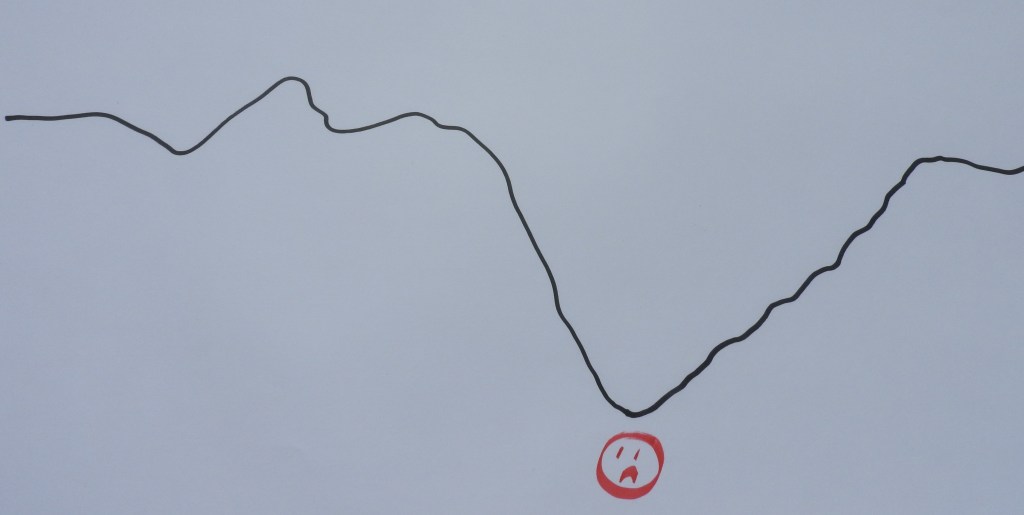
I drew the line below on the whiteboard in my office.

I often draw a line to show people that we are all following our thinking all day long. And as the quality of our thinking fluctuates so does the feeling we experience. Think harried thoughts about all the tasks that need doing and you will feel harried. Think angry thoughts and you will feel angry. Think grateful thoughts and you will feel grateful. Be open to doing whatever comes to mind and you will feel calm and relaxed. In the particular instance above, the young person had been going about their day when something occurred and their thinking derailed down a dark alley.

Interestingly, they didn’t act on that thinking – otherwise they wouldn’t be in my office.

I commented on this and asked what thinking came into their mind after the dark thoughts.

‘That ‘that thinking’ wouldn’t end well.’ Yep, that was true.

‘That I needed to get myself out of there.’ Made sense.

‘That I needed to speak to someone.’ Wise.

‘Where did all this thinking come from,’ I asked (pointing to the rising line after the unhappy face). To which they replied with the title of this blog post.

A ‘smarter part of us’, naturally surfacing, no effort, no struggle to change our thinking, just spontaneously erupting of its own accord to lead us back to a clearer, calmer state of mind. Everyone has it. All the young people who come in to my office concerned about self harming or suicide have it. So do the adults who know they are struggling but sense there is more. Most of us don’t notice it. Some listen to it, some don’t. How have we got to this point in our evolution in which we are largely ignorant of the workings of our ‘wired in’ resiliency and mental health?

Do we notice the relationship between our thoughts and our feelings? Can we see that our thinking is the mediator of all experience, whether it be of a rainy day or of scary thinking crossing our mind? Do we notice that thinking fluctuates? Do we notice the powerful change brought about by a split second shift in our thinking that arrived without deliberately conjuring it up? How does that happen? Do we notice the impact of insights on our habitual trains of thought? Do we wonder where shifts in thinking come from? Psychology tells us that once we have started along a negative thinking path it tends to keep going in the same direction. What it fails to remark upon and get curious about is the fact that our innate mental health never fails to offer up a thought that will bring us back to our senses – if we choose to follow it.

So much untapped and unexplored depth to the healthy human system of psychological functioning, already operating in everyone, but for most, outside our consciousness. Experiencing more of our mental health doesn’t require learning techniques to build anything in us, everything is already inbuilt. Experiencing more of what is inbuilt is simply about becoming aware of it, of having conversations that bring focus to all that operates in human experience and not just the slivers that we have dissected out to examine. Experiencing greater mental health comes with increased awareness of the fuller picture of the processes at play in psychological functioning.

Waking up. A moment of waking up to what already exists is all that is required to a deeper, more stable experience of our mental health. Seeing that we are experiencing thought, noticing a sudden shift in vitality and seeing its true source (effortless thought replacing rumination), realizing we can trust the thoughts that originate deeper within us more than the ones making noise in our heads, are all moments with powerful repercussions.

If you would like to experience greater depths of yourself (and not just what you were conditioned to believe), or are genuinely open to experiencing more fulfilment and satisfaction with your life, mentoring consultations are available with myself either in person or via Zoom. Please feel free to make contact at georginamavor@outlook.com.

Disentangling

In the world of personal growth, there are ‘many roads to Rome’. My particular pathway to liberation of the self and greater authenticity is journalling. The practice supported me to successfully navigate the dismantling of an emotionally unhealthy relationship and create a wonderful life. It is where I go to process parenting issues or questions about the direction of my work. It is also where I go to record insights as they come, observations about how our inner world works, and moments of intense gratefulness for the gift of being alive.

Over the years I have learned a lot from journalling. I have learned which thoughts to follow, and which ones to allow to float on by – another one always enters. I have learned to trust the feelings of my body and what they are telling me. I have learned to sense whether I am speaking from memory irrelevant to the moment or speaking from deeper wisdom within. I have learned to respect and trust my intelligence. I have learned that tension reflects a person’s ability to hear or not. I have learned to listen for conversations open to engagement and to speak when moved. I have also learned to not speak when learned habits from the past dictate that I should. I have learned to create healthy boundaries and to stay out of other people’s psychological entanglements unless they ask for help. I have learned to trust life instead of fear it.

When I work with clients I take note of the psychological entanglements some people get caught up in when speaking. Conversation patterns generated in families of origin, reflective of class, or created in response to trauma, are revealed. Some people have unconsciously learned to avoid the knowledge and wisdom accumulated through experience. These people have a ‘teflon’ relationship to their inner truth and the way they answer questions reveals this. Whilst others consciously reflect and speak from the accumulated knowledge and wisdom within. When someone speaks ‘with substance’ I can hear and feel the truth of it. When someone responds with a ‘teflon’ response it is as if they begin to move in the direction of what they know but at the last minute slide away. Somewhere they have learned to be afraid of what they know.

‘What activities do you like to do that make you feel good?’ -|-> (Authentic) ‘Snorkelling, I love the feeling of mystery when I am underwater and I never know what fish will be around on the day.’ .|C> (Teflon) ‘I don’t know, I don’t enjoy anything.’ On attempting a different pathway in, a childhood memory comes to mind which then leads to a surprising recall of something they enjoy doing as an adult.

‘What do you want to do about the marriage?’ -|-> (Authentic) ‘I’m done. I can’t do this anymore. It’s time to move forward.’ .|C> (Teflon) ‘He says he wants to change and make the marriage work but then he says its my fault because I never agree to what he wants to do.’ In this response, a speaker’s attention has been diverted to the words of their partner instead of their own.

‘Wow, you must be feeling really sad.’ -|-> (Authentic) ‘Yes, she has been my constant companion for over 20 years. I will miss her a lot.’ .|C> (Teflon) ‘No, I will be fine.’ As tears are swiped away.

Each of these ‘teflon’ responses reflects the activity of thoughts learned in the past entangling and contaminating present moment authenticity, wisdom and experience. In any moment we are either experiencing the truest expression of ourselves or it is contaminated by something we have learned, in the past, to think.

Many women have been conditioned to think of themselves as not the decision makers, as not intelligent and therefore not the person in charge, and as caring for things that are unimportant to society. All of this is not true. Society, families, relationships, and selves, need the voices from the depths of our truth. Journalling is one way to familiarise ourselves with the timbre and feel of that voice and to know when it has become entangled with beliefs and thoughts created in the past and innocently carried forward contaminating the present moment experience.

If you are interested in learning and experiencing how journalling can support you to become aware of the deeper, secure self that exists within everyone so that you can be in the world with greater confidence and faith in yourself, I am running a series of introductory workshops, in person and on line, over the coming months. All workshops will be posted on my facebook page https://www.facebook.com/GeorginaMavor.

Curious or Caught Up

When something troubling occupies your mind, do you view those thoughts with curiosity or do you get caught up in them? Both responses are manifestations of the innate principles of psychological functioning operative within everyone. One however is the result of a lack of awareness of how thought operates whilst the other is an expression of awareness.

As we go through our days, thoughts flow through our minds. And we follow them, most of the time experiencing them neutrally, with ease and grace. But every now and then, a train of thought emerges which is accompanied by feelings of unease. Variation in feeling is the natural expression of the Mind/Body connection. What we think, we feel.

Being aware of our feelings and knowing what they are telling us is crucial to consciously supporting healthy psychological functioning. Feelings tell us whether we are in the everyday flow of life, or whether we are experiencing an insight (a deeper, fresh thought) or whether something destabilizing is on our mind. When we are aware of the fact that we are only ever experiencing the thoughts on our mind, having a uneasy thought on our mind and feeling anxious is no big deal. Thoughts are like everything else – something separate from us to notice, to make a decision about, and sometimes to act on. The uneasy feelings some thoughts create is our body’s ‘siren’ – to notice and avoid going down the proverbial rabbit hole.

A ‘siren’ tells us to stop and pay attention. It doesn’t tell us to get involved with the accident. If we heed the ‘siren’, pause and get curious as to what we have on our minds, we work in harmony with our psychological system – instead of getting in the way.

Everyone experiences moments when we have something on our mind. My most recent experience was a feeling of unease, which when I noticed and got curious (instead of caught up), I could identify. ‘Oh, that’s interesting.’ Concern for someone on that day was one of the matters on my mind. Looking at it with curiosity, common sense told me that there was nothing I could do except be available to support emotionally should something occur.

The second matter however was in regards to work I had put myself up for. At the time, I thought it would be useful, but clearly something about it was niggling me. Later that day, clarity hit me – at this point of my life the work wasn’t for me. From that clarity, I emailed my decision to those who needed to know. No doubts, no second thoughts. That clarity felt absolutely true and right.

What did I do in between accessing curiosity about my feelings of unease and the arrival of clarity? I listened to what I needed to do to feel better, to feel at ease, to feel calm, and I followed through. I got back into the flow of life and the flow of thought. And from within that flow a moment of clarity, out of the blue, surfaced. I didn’t give the troubling thoughts on my mind a second thought. I engaged with activities that felt right, my troubling thoughts moved on and in the flow of thought coming toward me, the real substance arrived.

‘Comes and Goes’

Dwaarlindjirraap, Lane Poole Reserve, Dwellingup.

I regularly experience rushes of anxiety. Ones in which it feels as if life has no meaning or significance. In those moments, I feel afraid, alone and scared.

I think that as a psychologist I should have all the answers for moving anxiety on quickly when it comes knocking on our doors. But I don’t. Sure, there are some strategies that occasionally work for me, and possibly work for others as well, but I don’t have a ‘method’ that works every time, and over time.

For my experience of anxiety has changed over the decades. In my earlier years, it was more a ‘daily living’ default setting. Now, my ‘normal’ is much, much calmer, and intermittently, there are bouts in which life feels scary. Interestingly, over those same decades, I have crafted a rich career; formed committed relationships; raised a child; navigated adolescence, mid life and all the years in between; grieved the loss of loved ones and loved animals; and managed health concerns as they arose. I have lived in spite of anxiety and other psychological ‘phenomena’.

Regardless of anxiety’s presentation, I do know its experience is created from thought, but that knowledge rarely helps me in the moment. I experience anxiety, and think ‘it’s just thought’, then what? Sitting in a psychological limboland without the rudder of another thought is equally scary. What actually ‘helps’, is the ‘coming in’ of another train of thought. One moment, I am sitting by the river, fearful of being alone and alive, five minutes later I am filled with warmth at the sight of human interactions occurring at different campsites as I return to my tent. My soul is balmed. Another moment, I am afraid of the week ahead of me and the next I am so happy to be able to sit on my couch and watch another rerun of ‘Rake’. That’s how life goes, one moment this, the next that.

Whilst I can offer a list of thoughts and actions to deliberately ‘bring in’ another thought/feeling, I also know that if I just allow my emotional experiences to ‘be’ and keep living, another train of thought/feeling will arrive. The past passes. Just as hayfever passes, or not getting to sleep passes, or a cold passes. Rest, take care, and living takes over again. Physical and psychological experiences, uncomfortable and comfortable, pleasurable and distressing, boring and intense, are all a small ‘passing’ part of the ‘mix’ of living.

Rather than come up with a list of strategies for moving ‘anxiety’ on, maybe our psychological resources would be more usefully spent on the main act – living a life we like. Because its the thoughts of things we like that ‘come in’ and nudge out the driver thought behind the experience of anxiety. Maybe living lives we like is what we can know better and more about, because we already know what we need to know about anxiety. It comes, and goes, when a ‘nicer’ thought comes in.

Perspectives Are Equal Until Depth

Artwork by Ilaria Valtolina

Have you noticed how some of us can spend too much time talking about what others have said or think about us, and what we do, whilst we pay significantly less attention to our own perspective? Imagine an art class. In the centre is an object or person to be drawn or painted and on every student’s easel is a unique and different perspective, one of which is our own. Time is spent looking at and absorbing each, sensing for the nuances captured in each representation. How much we could learn from this process. When I hear people caught up in other people’s perspectives, I wonder what happened to their own? Why was it discarded so quickly?

Many decades ago, during my own journey in the Family Court, the standout piece of advice my lawyer offered was to stand up for what I believed in. Even if my perspective wasn’t deemed by judges in the end to be the ‘soundest’ one, my lawyer was of the view that to have stood up for what I stood for, was better than asking myself ‘what if’ when it was all over. I took that advice and gave my perspective at least equal standing to that of the other party. I hung on to what I knew was true for me – until I heard anything to the contrary that would change that perspective, which did occur every now and then.

Everyone has a separate perspective (reality) on everything in life, and we all have separate perspectives even when we are looking at the same thing. To ‘hero’ one perspective over another reflects a misunderstanding of the fact that everyone is creating their own perspective, their own reality in the moment and none have any greater accuracy or validity – until something deeper is heard. And that can only occur if initially both or all perspectives are given equal space of our minds.

The next time you find yourself emphasizing what another person says or thinks or does, stop, turn inwards and consider what you think. What’s your truth? Hang it on the wall of your mind alongside others. What in your perspective feels true? What evidence do you have? We are all brushing up against the ‘elephant’ of life. It is bigger than a lifetime will allow us to know completely. No one person can.

And if someone else doesn’t want to hear what’s in your perspective, then they suffer the same error, only in reverse. They ‘hero’ their perspective over others.

Every artist begins as a beginner. Every artist must begin. Every artist must put something on the canvas in order to begin the process of going deeper … seeing something different … more nuanced …more truthful. The same applies to the palette of our mind. Begin with what you know. Begin with your truth. ‘Hero’ it just as much as you ‘hero’ the perspective of others. And when you hear something more truthful, allow it to touch the canvas of your mind and imbue your truth with depth.

Behavioural Experiments of the Mind

We are all the directors of our experience of the story of our life. Our story has a beginning and an end. It has unique content. In between, we get to choose where we focus the camera of our awareness and the point of view of our thinking.

The craft of a great director of our human story is in understanding and deftly working with our thinking and feelings.

In all the myriad of details we can focus on in each moment, we unconsciously choose what we pay attention to — until we become aware of what we are doing. Alongside our attending we are interpreting, using the words and images from thought to make meaning, even if that meaning in the moment is to operate on automatic.

We experience where our thoughts meander.

Often we change direction, instantaneously experiencing the miracle of the mind body connection. We change our mind, our attention is caught by something, we have an insight, we hear the logic in another person’s words, we become immersed in a flow experience and … what we are experiencing in our bodies changes.

We experience where our thought moves.

Our thoughts, whether in the form of words or images are not ‘facts’. They are akin to clay, something we can shapeshift. We may not be able to direct what comes in to our minds (and maybe we can), but we are able to choose which forms to engage with and which ones to leave behind. We can direct the experience of our life story, regardless of its content.

As a therapist, I will at times set behavioural experiments for clients to discover for themselves what I point to in our sessions. I also utilise them when I too get caught up in an uncomfortable perceptual lens that takes me nowhere. Try them for yourself. See what you learn about your capacities as the director of your experience, about the creative nature of thought, about your own habits of mind and about the so-called truth of much of what we think, particularly about ourselves!

1. The first step is to notice. Notice the feelings in your body and check in with what is going on in your head. If this isn’t possible in the moment, hindsight is a remarkable human tool. Look back at the experience you have just been through. Look at the thinking driving it. If you acted on it, what was the result? If you didn’t act on it, what was the result? Much wisdom is gained in life through hindsight, when we see how behaviours that erupt from a troubled mind usually result in more trouble. Noticing is a powerful inbuilt mental health faculty.

2. When caught up in overwhelm, with a list of things that must be done running through your head, go in the opposite direction. Stop, ask yourself what you need to do to slow down your mind and your actions — and do it. What did you learn? How important was all that stuff you had on your list? Did the world open up and swallow you when you stopped all that pushing ahead?

3. When you are caught up in hurt and pain, wanting to lash out at others, stop and look after yourself instead. Be kind to yourself. Write in a journal, have a bath, dress in your favourite clothes, soften, be gentle to you. The other person may not be kind to you, but you can assuage your hurt by being gentle with yourself. And once you are feeling better, you can then decide what to do with unkind people in your life.

4. When your mind drops into a low mood, when everything about you appears gloomy and you have no energy — do something. Do something that fully engages you. Run, ride a bike, play chess, garden, walk in the sun. Those gloomy states of mind can be dangerous. They aren’t a life sentence, they are a thought created psychological state playing out in your body. Experiment with relating to it as a ‘state’ rather than a ‘trait’. Know that the true ‘trait’ is the power of awareness. If we can see that we are gloomy then what is the true self? The gloomy abyss or the point of awareness that sits above it all. Instead of buying into the gloom buy into the awareness. Act from there and see what happens. Did the gloom disappear? Did it shrink? What did you notice about your attention and thinking as you wavered between the activity you engaged in and the gloom in your mind. What we attend to expands.

Always notice, then when in a calmer state of mind, listen for what needs to be done, if anything. Not only does a director have a keen eye, she/he also taps a creative faculty when problems are encountered. How else would brilliant stories in films and books be created? We need the content of the story — and we need the interpretation. It is the latter that captures us, inspires us and reflects the hope that is inbuilt into life. Hope is part of its nature. Hope is part of our nature. It is part of the effervescent vitality of life. But it is hidden if we stay in ‘stuck’ states of mind. Developing our director skills in choosing which thoughts to privilege and which ones to walk away from is a key skill to determining whether our story is one of fulfilment or one of suffering. Which life story will you direct?

PS. The information provided in this post is for general information only. Appointments are available for anyone in Australia seeking more personalized support either face to face or via Telehealth. Please call 08 9330 3922.

Photo Courtesy of Denise Jans, Unsplash.com

Reality is Sooo Sane

“I told him I knew he was frustrated because he didn’t win, but throwing his toys around will only break them and that would make him more unhappy. Quietening him down, I told him to take a few deep breaths so that we could get back into the game.” Words of wisdom from a young mother who has suffered anxiety most of her life, bringing sanity to the behaviour of her young Autistic son.

“Stop. I’m not helping you with your job application anymore if you continue to vent your frustration at me. I’m only trying to help but you do this every time you have to read and writing something. I too have things to do and don’t deserve to have someone angry with me when I am just making myself available to help. Come and get me when you feel you can stay calm. It might take time, but we can get it done.” A mother helping her teenage daughter who struggles with literacy.

Frustrated with the exhaustion of breastfeeding my only baby at 44 years of age, I finally accepted the reality that I was finished, that I just didn’t have the energy or support resources to maintain what the textbooks told me was good for my child. I had begun to turn to a glass of wine each night to keep me upright. That didn’t feel right. It was time to accept the physical reality of my situation, support myself instead of overloading me, and move on. No more breastfeeding, no more needing to prop myself up. Solid food only and move into the next phase. She turned out fine and I felt human again.

Reality is sane. Physical, emotional and cognitive limitations are sane. Live within them and we navigate life with greater ease. It’s our thinking disconnected from common sense that takes us into insanity.

Children need help (when their frustration with reality takes hold) to see that their frustrated behaviour will hurt. Destroying their toys or throwing themselves about doesn’t make their satisfaction with themselves or others better. Taking a few breaths and moving forward helps. Leading our children through the experience of  responding with common sense to reality supports the integrity of their inbuilt psychological health system.

Yelling and abusing the people who love and support us affect their level of comfort in being around us. In choosing abusive and disrespectful behaviour because of frustration, we impair the social connections that enable us to survive and flourish. An adolescent has the ability to know that their behaviour may hurt the love they value, and they have the ability to choose whether to engage in it or not. We can help them pause and choose, if we use language that separates their frustrated behaviour from who they are. “I really want to help you, but that behaviour is getting in the way. I want to spend time with you, but not if that behaviour erupts. I will assume that you know how else to respond but if you want to talk it through, just let me know.”

Adults have even greater cognitive capacity to bring better quality thinking grounded in reality to a situation. Instead of being caught up in some picture of what ‘should’ be happening, acceptance of what’s working for us or not is a pretty reliable gauge by which to decide whether to continue or to shift. If something isn’t working, step back, and choose what would work.

Help young children experience ways of soothing their frustration that don’t hurt. Ignite awareness of free will in adolescents and young people by using language that separates behaviour from them as people and affirms the ability to choose. As adults, get out of our heads and listen to the sanity and common sense in the reality around us. We all possess the capacities of awareness and free will. We can all choose something different even when caught up in strong feelings. It’s common sense. Everyone has the capacity to notice, to know what isn’t right for us, and to exercise free will. Those capacities are inbuilt into us and already operating. Begin by noticing when we are caught up in something. If it doesn’t make sense, stop. A saner response awaits.

Warning Bells

There are many sad hearts in my local area this week.

Mid week, a Year 12 classmate of my daughter was stabbed. Hours later she died. Neighbours reported hearing an argument. In a heated moment, a strong impulse was followed and a life was cut short whilst others were altered forever. The sadness in our community is palpable.

In a classroom, a gentle hearted boy gets caught up in the moment and follows an impulse. He does something stupid and is suspended. The act was not worthy of suspension and neither was the boy. He can explain what happened, he can explain how conditions in that room are difficult for him to navigate, and he can articulate what he needs in his environment to learn. But the adults around him got caught up in their own impulses and no one listened. In that brief moment, another life trajectory was altered.

A mother reacts badly to her children being children. Overextended and exhausted she flies off the handle with rage at the smallest things. She moves her children through their day and when alone she sits crying in the car at the mother she has become. She is frightened at how powerful is the impulse to lash out, she is frightened at her inability to stop it, and she is frightened of what she may do. She knows where that impulse could lead.

These scenarios are but a small slice of the instances this week in which children, adolescents and adults in my small part of the world followed a brief, strong impulse, resulting in sad, despairing, and frightening outcomes. We need to understand that strong impulses ….. strong emotions, are not reliable truth. They are warning bells, not invitations. They are signposts that we are about to step into a train of thought that lacks wisdom. They don’t end well.

Photo courtesy of Amel Majanovic @just_amelo Unsplash.com