Internal Tremors

‘Wishing you a finely tuned, in depth conversation, between your inner most self, and the universal horizon.’ These were the words theologian Sylvia Grevel wrote in response to my revelation that my working life had taken a significant turn. I did not know what lay ahead.

Shifts in alignment between my inner most self and the outer world are erupting. Significant personal and work related incidents since Christmas 2022 have caused me to pause and reflect. My questions and book purchases have also led me to the workshops and supervision provided by Monica Suswin. In one of those encounters, I realised my inner most self was not supported and I needed to respond. I heeded Monica’s warning about unshackling myself too quickly from non nurturing contexts and so I happily continued trusting that I would act when I ‘knew’ what next, and open to the ‘other’ possibility that I may be in the right place.

I spent two glorious weekends away – one with Sylvia – nourishing the inner most me. This monring, I was ready for my working week ahead, and had intended to complete casenotes; write up the draft to a journalling workshop about ‘Writing into (not for) Wellbeing’; and complete a few outstanding admin tasks. But in the background, something else stirred. I knew I had to withdraw from a commitment. Whilst there was no intention to create dissension, I somehow felt that what I was about to do would unsettle everything.

It did.

Whilst the unravelling rolled out, I listened to a webinar interview with Eric Teplitz through my membership with the International Association of Journal Writers, an organisation I recently joined to support the “Journal Writer who happens to work as a Psychologist’. Eric raised questions about whether we thought possibilities sat latent in our lives – we do not know what may surface tomorrow. I realised I hadn’t believed in the possibilities that awaited me for a very long time. Possibilities, in my mind, were exclusive to younger lives.

Eighteen years ago, I turned to my journal to explore the possibility that wisdom lived latent in the darker recesses of my being. It turned out that it was not so latent, that it had been active all my life, and that my only ‘error’ was to not recognise it. A cycle has been completed and I now embark on another one, one that exploits further the power of something invisible but operative – a conversation between my inner most being (wisdom), and the universal horizon.

Since running community markets some years ago, I have been a big believer in putting innovative ideas and thinking on the horizon. Those innovations open up possibilities for everyone. So now I offer another one, one based on not knowing, on listening, on journalling to hear, and on trusting what surfaces. I am not going to do what I may have done in the past to secure my future. I am not going to scramble and put things in place. I am going to explore the possibility that between now and end June 2023, possibilities I could never dream of exist for me. With my journal to capture the questions, to write into the questions, to reveal thoughts and ideas beyond my current ‘stock’, let’s see what unfolds.

Releasing Resentment

It was one of those nights in which sleep eluded me. My mind was fixated on a conversation that had occurred the day prior and couldn’t let go of the perspective it had taken.

On rising the next morning, I sat with my journal and wrote. Once again, I was blessed with its fruit.

My writing revealed my resentment at someone’s inability to take a stand. Inability is the key word, for they really were unable – but my mind had simply ignored that fact and instead clung on to the incorrect view that the person could take a stand, and should. My ill founded thinking was the cause of my resentment, not the person – but it took my writing to see that.

I wrote about their early life, of the experiences they had endured, and of the mechanisms they had creatively developed to survive. Taking a stand was not one of them. Taking a stand incurred violence. So instead, they learned to hide, and as an adult, to keep ‘messy’ people and ‘messy’ life out of their lives. Whilst voicing strident opinions with an intensity that reflected their fear came easy, acting on them did not.

It made sense. Our early years are the context in which we learn to think so that we survive and stay connected with people. Unconsciously, it becomes our ‘manual’ for navigating life. ‘Don’t speak up’, ‘don’t annoy anyone’, ‘work hard’, ‘don’t try’ and endless others become ‘chapters’ that steer our engagement with life from behind the scenes.

As my writing revealed this person’s history, compassion rippled through my body. I understood how difficult it is to break out of a lifetime of unconscious psychological habit, something that can only occur if we trust the core of who we are. None of this person’s early experiences inserted that ‘chapter’ into their personal ‘manual’. My resentment was ill founded.

If you are feeling resentful towards another and wish to move on, I invite you to sit down and write about the situation on which you have fixated. Articulate on the page what you think the person should have done. Be honest with your recount, because it is this thinking that is getting in the way. Then reflect upon what that person would have needed to know about themselves, and the experiences they would have needed in life, to become the sort of person you expect. Then write about the early life they had and how they learned to survive in that context. It’s no good resenting someone for actions and behaviours they have no idea how to execute or that they are not capable or free to do so. Like canaries in an open cage, rarely is anyone completely psychologically free to live congruent with the active intelligence that animates us. We all possess our own straightjackets.

Always Learning

When we think of learning, what comes to mind? Babies learning to walk, children at school, learning to drive, learning on the job, and learning at university. In these contexts – early childhood, new skills and educational environments – it is easy to identify that learning is taking place. But what about the learning demanded of us when we become new parents? Or learning how to be in relationship? Or the learning required at the tail end of life?

Because the need to learn never ceases – not until our final breath. The older adults I work with in residential care are learning to live in an alien environment; they are learning to live with bodies that lose functioning every day; many are learning to live with impoverished family connections; they are learning to allow strangers to support them; and they are learning to die.

As with all learning, some do it with grace, whilst others struggle. Some only see the loss, and become frightened. Whilst others accept, and see the opportunity for learning about their deeper selves; about the people around them; about relating; about life … and death; and enjoy the final ride.

When our old people in residential care are whining about their medical woes, or their lives, remember two things. (a) They are attempting ‘personhood’ in the best way they know how. By talking about what they know but from within the diminished context in which they now live. Everyone outside residential care has the breadth of life in which to engage, and discourse. They have functional bodies that move in varied contexts, with varied people, with varied purpose. In outside contexts, it is easier to have something to say that others will find interesting and engage with. And, (b) They don’t realise they are learning. In time, if their social circles and engagement with activities increases, their narratives will change. If not, their narratives and vitality will diminish. And if open to learning, what they understand and think will find a depth incomprehensible to those busy with life.

Our older people are learning, and transitioning into residential aged care demands it even more. Validate the learning they are doing. Talk about earlier times in which they valiantly met similar challenges. Talk about what they are noticing in themselves. Get curious about what it is like. Harness their learning. Adjusting (learning) requires that we allow new experiences, people and understanding in. Recognise the inner being learning to adjust to different physical, social, familial, personal and spiritual circumstances. Listen and affirm their efforts. Champion the hero/ine within and help them to flourish as their bodies and lives diminish.

The Nature of Thoughts

If plants possessed attention, where have they pointed it? Is it the same for human beings?

The human mind is a thought generator. Turn it to how much you dislike someone or something and it will generate thoughts aligned with that direction. Turn it to something you are passionate about and it will generate thought aligned with that direction. Unlike plants, we have the free will to turn our attention in whatever direction we choose. To possibility and something fresh … or to the ground hog day of habitual ways of thinking, feeling, talking and acting.

In preparation for a journalling circle recently, I initially turned my attention to memory – to what I knew and how it would structure a probable outcome. But in the back of my mind, an image from a journalling group several years ago, kept ‘knocking’. I wanted the lightness and feeling of that moment in our meeting.

So, I put aside what I thought I should do, and sat with the feeling. The thought came to pick up a book about journalling and browse. Again, my intellect wanted to categorise into useful and not useful, but instead I let the feeling guide me. I resisted the prompt that resonated. ‘List the milestones in your life, add a few details and write about one.’ My head said it was too banal, but I chose to trust the nudge, and wrote up my preparation.

Wow, what a rich time we had. No one writing yielded the boring writing I had anticipated. Everyone accessed something fresh and new.

‘I’m the driving force of my direction.’

‘Living smaller doesn’t mean living smaller.’

‘Whatever is to come, I know I will be okay.’

‘I can choose to enjoy the time before me.’

In the myriad of the words we wrote, a sentence or a phrase in each piece ‘grabbed’ us. The human mind is a thought generator, but not all thoughts are equal. In the midst, deeper truths can be felt. Maybe there is more in common in the Nature that animates us and plants than we think.

Sinkholes in Consciousness

Slap, slap, slap, slap. The sound of sandshoes pummelling the footpath every day as my 9 year old self ran up the hill of the road home in an attempt to beat the bus. 1960’s shoes and shoulder strap school bag didn’t make it easy. If the old bus chugged past before I made it to the top, I’d stop running and stoop into despair that I had ‘lost’. Beat it and I was a winner. The fantasies that go on in a child’s mind. Adrian Mole and Horrible Henry aren’t the only ones narrating their lives.

The only problem is that that narrative became my mantra. Whether in work, or relationships, or health, I have pushed myself beyond what is humanly healthy in order to reach a bar I had set too high in order to validate my worth.

Five decades later, I am finally listening to the nudge within that serves me better than my conditioning. I am called to slow down my inner world, and to let go of the narrative that orders I do this, this and that, before I can feel okay. It’s time to move with grace. It’s also time to prioritize writing about moments that resonate.

So I was disappointed recently to find myself agitated at the end of the day. As I swept the kitchen floor, the realisation came to me that I had been using an hour of DVD watching of an evening as my ‘reward’ for having slowed down during the day. On this day, however, work tasks had taken a little longer and the ‘reward’ was thwarted. No wonder I was tense! How grateful I was for the fruits in awareness the disruption unearthed.

Oh I was amused. Like a sinkhole in consciousness, this childhood cognitive firing was at play again! Conditioning had usurped open presence. My mind had automatically made ‘reward’ meaning out of time at the end of the day. Realisation freed me and I knew there were no ‘rules’ about how I used my time. Categorising my activity into work, or leisure, or reward, was all made up! The truth is that every moment is full of possibility – and I am free to follow the internal nudge.

Another wonderful lesson from life on how to avoid habitual cognitive sinkholes. Slow your mind down, be present to where you are, and step into the nudge from within.

What if we’ve got ourselves all wrong?

What if we’ve got our understanding of ourselves all wrong? What if we’ve got our thinking about how we need to use thinking all wrong? What if the innate capacities that drove Neanderthal man forward in evolution (without a book or teacher) are just as present in modern day man? What if, just as those capacities enabled Neanderthal man to successfully navigate his context, they are just as available for successfully navigating our context, and the contexts of the future? What if the way we think we have to relentlessly think about everything in order to live well is actually getting in the way of the capacities inbuilt to human beings that are the real drivers of change, thriving and evolution?

Innocently, we may have taken a wrong turn and the pendulum has swung too far out. Like mushrooms spawning, books, information and websites on how to manage our emotions, psychological states, parenting, relationships, business, performance, etc. now envelope our lives, each of them telling us how to do this, how to do that. It is humanly impossible to do everything they say, and yet each proposes that its contents will make us more effective – the implication being we will fail if we don’t. No wonder anxiety is so prevalent. Is it really true that we innately lack the wherewithal to successfully navigate life without an ‘expert’ somewhere guiding us? Or have we innocently lost our way and lost sight of what makes us human – the capacity to successfully navigate all the complexities of life – if we slow down the busyness of our thinking.

What if we settled back into an assumption that we have got what it takes and let go of running to do lists, schedules, books to read, classes to attend …. being in control. What if we played with letting that internal state go and gave ourselves permission to experiment? What if we maintained a quiet inner state for a small part of each day, what would we discover about what Neanderthal man innately trusted because he had never been taught to doubt it?

Bending Reality Out of Shape

When people come into counselling, I suspect they think that if we just talk about everything, that in some miraculous way, it ‘fixes up’ the content of whatever is going on. The problem is there is SOOOO MUCH going on.

People not liking what we have done, people wanting more from us, unhealthy workplaces, poor relationships, addictions, people dying, sickness, struggling children … the list is endless. All of these issues benefit from a bigger perspective conversation. But the amount of time this would take is unreasonable, and new ‘problems’ surface along the way.

As part of her current More Signal, Less Noise 5 Day training Barbara Patterson presented a simple understanding of how everyone perceives in the moment – including ourselves. We are either interpreting life (and ourselves) from clarity, or we are interpreting from an agitated internal state and our thinking distorts reality. It bends it out of shape.

See the actions of a family member in a clear state and we see their acts of kindness and care. See it from an agitated state, and we distort our attention and thinking, catastrophising one small detail. See our own agitated internal state from clarity and we experience compassion. See the same internal state from agitation and we distort our experience into shame. Sensing whether ourselves and/or others have a calm internal climate or an agitated one, makes all the difference in knowing whether we, or others, are seeing clearly, or whether thinking is distorting reality.

Knowing this simple understanding provides flexibility in response as against groundhog day of repeated neural firing. If I know I am perceiving from an agitated internal climate, I can choose to sit still, breathe, redirect my attention, listen, etc. If I can see that the other person is expressing from an internal agitated state, I can choose to calm them down, distract, or I can walk away.

Everything going on in a person’s life can’t be talked through and ‘settled’ into place. But everyone can discern whether they and/or others are seeing clearly, or are innocently distorting reality. Familiarising ourselves with this simple ‘tool of awareness’ then opens a portal to forming a conscious relationship with the Me behind all the distorted thinking. The Me that nudges, realises, insights and knows – even when an internal tsunami is underway.

Journalling for the ‘Gifts’ in Christmas

What an awful Christmas. I am grateful for its ‘wake up call’.

The impact of people disconnected from the essence of the ‘spirit of giving’; the unexpected death of a close friend; fast failing terminal health in another; and untethered expressions of nastiness, all ‘woke’ in my consciousness over Christmas. Taking time to write and reflect by my local lake revealed blind spots in my thinking, peeled away layers that had reached their ‘use by’ date, and deepened fresh awareness of what was needed to move forward.

A slight breeze rippled the lake whilst walkers and joggers chatted and panted. In the muted sound and light of early morning, I recorded the content of my busy and discombobulated mind.

The spirit of giving whether in the form of a small gift, effort, or time, is important to me. In the lead up to Christmas, my daughter and I took great enjoyment in baking, making and wrapping. Friends and family responded in kind, either in appreciation or with another small gift. But a few significant recipients didn’t. It wasn’t the first time. Free flow writing revealed chasms in values I had not acknowledged, and opened up a pause in which to consider ongoing investment in connection or not. It was a significant decision, and I wrote over several days until my words settled. ‘Shallowness’ that does not sustain and nourish the human spirit is now less in my life and my time is free to invest in relationships more aligned with who I am.

Writing about the unexpected death of a close mate revealed a mirage we all played into, denying us time to say what mattered. We assumed that because doctors were ‘monitoring the situation’, we always had tomorrow to look forward to and that the ‘work of maintaining health’ would take a break over Christmas until services returned from holidays. But Christmas isn’t a pause button. Unanswered phone calls can’t now be answered tomorrow – he’s gone. Writing revealed the need for greater courage and authentic conversation with those not doing so well healthwise, regardless of health professional involvement.

Nasty communication also appeared in the array of human interactions over the festive period. Writing about the personal impact revealed (again) how easily very old learning is activated.  Once upon a time it allowed me to survive a tough environment and to keep living into the future. But I am no longer a child and nor am I in school. We all age and context changes. As that neural wiring calmed, my writing revealed clarity about the people involved now. I didn’t have to engage. Their use of nastiness revealed their psychological functioning. I was not the one to help. Writing about and through that emotional pattern reminded me to be more discerning in who I trust and the depths of care I invest. There are people we can be intimate with, others we socialise with, others who we negotiate in business, and others we walk by.

My pen recorded it all in my journal.

When we are busy navigating life and reaping the efficiency rewards of all the learning we have internalised to automaticity, we can miss valuable information in the present moment. Human learning mechanisms are great for learning to drive a car, but less reliable for more complex matters of living. Slowing down, and prioritising time to journal can reveal understanding in the present moment not recorded in the wiring of our old learning.

Post any intense emotional experience, I invite you to write to the following prompts:

  • Name and describe what you have been through. Be honest. No two people have the same experience. Our thoughts are the ‘ingredients’ of our unique experience. They are the amazing culmination in evolution that allows us to navigate life with efficiency. Identifying and naming the thoughts contributing to experience reveals the limitations of past learning, and nudges questions that take us beyond what has become unconscious (learned to automaticity).
  • Name your expectations (also thoughts). What were your expectations and what did the experience reveal to you about the true nature of life, including the people in it?
  • How do you feel about the match/mismatch between the reality and your expectations?
  • What implications does your deeper, more conscious, understanding of reality have for how you live in the future? What changes would you like to make? Do you have the courage?

Roads … and Where They Lead

I’m at a turning point in my life and whilst I’d like to only make ‘moves’ that are comfortable and are assured of a positive outcome, sometimes we just have to jump into experience and see where it leads.

Yesterday, I returned from a weekend away camping – on my own. A new experience, not necessitated by retirement, but rather brought about by the rounding out of 18 years ‘late in life’ responsibility for single parenting. Intense active involvement is no longer required. What to do with all the free time I now have in a personal life bereft of satisfying social activity?

Start with the activities I do like and go from there. Being in nature, camping, journalling, ‘barnstorming’ (without the plane) down neverending unknown West Australian roads that pass through towns marked only with a building or two. I booked a favourite camping site, loaded up the car, opened the door for my Red Cloud Kelpie and drove off.

The camping spot is just over an hour from Perth. Located in forest country along the escarpment running down the coast, it experiences more rain than its neighbouring regions. We woke on Sunday to thunder and my dog whimpered under the sleeping bag whilst I relished the tinkle of raindrops on the swag roof.

After the storm passed, and breakfast was done, we ventured to a section of the river I had identified the night before as an alluring swimspot. With no one else around we both luxuriated in quiet isolation. This exquisite moment revealed itself as the highlight of the trip.

What to do next? I had already written many pages in my journal, begun reading a new novel and made a start on this blog piece. With limited external ‘drivers’ to snag my mind, it had immersed itself in trains of thought about the folly of coming away, how I could be at home (but bored with what is becoming an entrenched daily routine), and my lack of social networks. Giving in to my lowered mood and returning home would only provide more of what I already knew. That didn’t feel right so I waited, and other, more enticing ideas arrived.

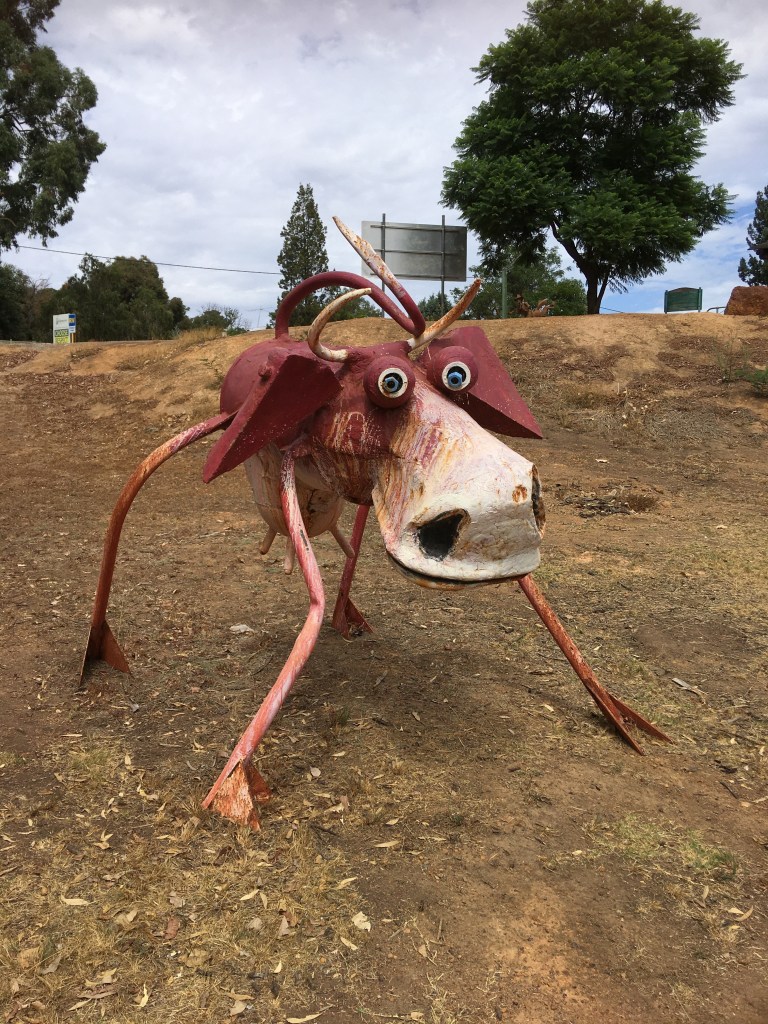
With the campsite packed up, I hit the bitumen road and drove an hour inland to the next town – Boddington. The townsfolk seemed to enjoy building local sculptures out of defunct farm equipment. It was hotter than our overnight stay and Shire signs forbade swimming in the river. Whilst the shady campsites were enticing, no swimming mitigated against staying. My dog, however, ran through the shallow edges of the riverbank. It was only as we were about to get into the car that I noticed her black, oily, smelly feet. She could not take them into the car. Ten minutes later I found a tap and spent 5 minutes washing her four paws. My hands were black. What was in that sludge?

On the road again, we drove in a different direction, further south and inland. Sheep land. Hundreds of them standing around the edges of water holes in the middle of dry arid paddocks. I wondered how many sheep farmers lost on days when the temperature was 10 to 15 degrees harsher.

At Quindanning I took a photo of this church. The square turret seemed out of place. The pub seemed busy judging by the number of cars outside.

At Williams, I got excited about what I would find inside the ‘Williams Woolshed’. Whilst it accommodated a great looking cafe and a huge display of products like wine, oilskin products, emu skin shoes, natural health care products, local books and wool attire, I was disappointed to realise not much of it was local. Real local people, living real local lives, is what interests me. What do they create out of a dry, isolated landscape while the sheep do their thing? What does their creativity inspire? Another product from interstate or overseas held no interest for me and the op shop in the old building next door was shut. It was time to move on.

It was now mid afternoon and I had to decide whether to drive home or find another place to camp for the night. Finding another place with water nearby was looking bleak so I turned for home. Little did I realise it would take another two hours at least to get there. I also didn’t realise how tired I was. Whilst the drive was a strain, I did come across signs to places I had previously earmarked to explore. At least now I had reference points both in terms of location and travel time. I also identified a few places of interest to explore along the way.

Overall, my camping trip wasn’t as I had anticipated. Whilst there were moments I relished, it wasn’t the pleasure I yearned. I know that both my enjoyment and despondency were a reflection of state of my mind at the time. One moment I was thinking that the opportunity swim in a pristine natural pool with no one else around was bliss, and in the next I was wallowing in thoughts about how isolated or tired in body I was. The weekend was an endurance test of my mind.

One I am glad I experienced. Even though I didn’t happily enjoy every moment, giving into my low state of mind would have robbed me of what I learned about myself and my terrain, and none of that which unfolded on my return would have unfolded. My experience provided me with information about the location of places of interest. I can now plan more confidently. I learned I need to take my good camera. I also now know much more about myself. I no longer have the stamina to drive for long periods of time. I need to take that into account. And I really do need to participate in activities other people organise.

Which is why, on my return home, I booked into several group events run by one of the fb camping pages I belong to. It is time to meet new people. Taking into account my reduced driving stamina, I have chosen events that are closer to home. With more experience and familiarity I will ‘range’ further. Small steps. Incorporate what I have learned and keep going. A low state of mind is like the sludge on my dog’s feet. Wash it off and keep going, even if you have wet uncomfortable feet. Do nothing and the sludge of a low mood state of mind becomes encrusted. The possibility of experiencing different destinations diminishes. All actions lead somewhere, including the inaction in response to low states of mind. They are nothing more than sludge. Keep travelling down different roads of experience, and relish what they bring, even when uncomfortable.

Dishwashing Zen

At 9.00 pm, after a 10 hour day, I am doing the dishes. I notice I am feeling quite energized and alive. Other nights, I feel tired and haggard. I know my vitality level is created from the state of my mind. Open and free flowing, and my vitality levels rise. Occupied with ‘hard’ thinking and my vitality drops. Tonight, I have nothing on my mind. My attention is fully occupied by the dishes and being in my home.

I’m aware I can easily change my experience in this moment. Think differently. ‘I’m so tired. I hate always having to do this at the end of the day. And then I don’t sleep!’ Result? Feel tired and haggard. I think how funny it is that with a simple switch in thinking I change what I feel. Same activity, different thinking, different feeling (experience). I feel entertained with that thought. I reflect on the fact I don’t have a dishwasher. I think ‘dishwashers are unenvironmental’ and I feel distaste. So I don’t have a dishwasher. Everything starts with a thought.

My Red Cloud Kelpie stands at the door waiting to go outside. I think ‘she’s cute’. I caringly let her out. One minute later, she is waiting at the door to come in. I think, ‘she’s a pain in the butt’. I feel annoyed and let her in. Another moment of ‘hard’ thinking creating a harshness in feeling.

I think that tracking my thinking and feeling moment by moment is a lot of work. I feel tired. And on, and on, and on, it goes. Thinking and feeling.

For all of us.

All of the time.

I think ‘how amazing we are’. Guess how I feel.