Focus Makes a Difference to Fulfilment

Decades ago, I was in a relationship that reflected the cycles associated with intimate partner abuse. It was crazymaking. I read every book available and sought help from numerous professionals. Endless seeking of information got in the way of doing what was needed. Leaving. My confusion was in my head. In my being I knew that what was being said and done wasn’t loving. That simplicity was all I truly needed. The rest was unnecessary complexity.

I see those same internal psychological dynamics operating in client presentations. People say they want something, but instead of taking action to make that happen, they get lost in a sea of thought and information from youtube channels, Instagram, internet sites, other people’s comments, professionals and self help books. Instead of information informing personal experience so that we can take action more confidently, for many its endless elaboration leads nowhere and action is stymied. The simplicity is that if something doesn’t feel right, then something in it isn’t. Trust that.
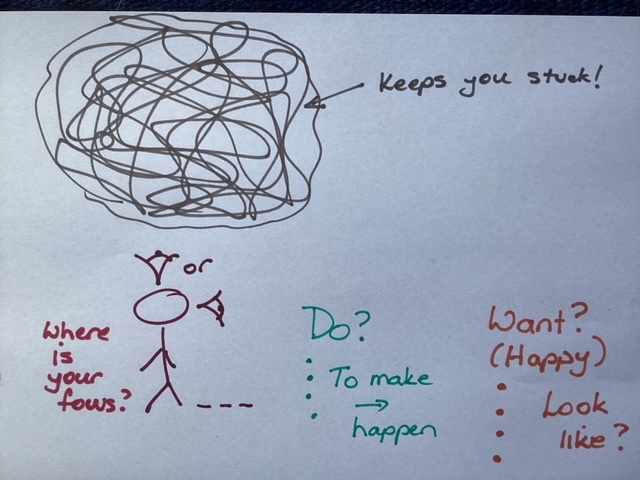
I often use this graphic in my consultations to reflect the internal dynamics of what happens. If we get out of our heads, logic usually informs what needs to be done. Maybe that is leaving a relationship, changing a job, moving someone out, getting on with studies, letting go of someone. Instead of working with the logic of what we know however, many people flip into their heads, rummaging through the various information they have read, what others will think, why they can’t do something, etc. etc. No one ever succeeded in life via that route. They succeed by getting on with things, even if it is new, they haven’t done it before and they are a bit afraid. Courage outweighs unfamiliarity. Because that is how human beings navigate the ‘new’, the ‘unexpected’, the ‘needed’. They get on with it, maybe not perfectly, maybe not even successfully, but they focus on what needs doing and do it.

Just as how we read has changed with the introduction of screen based print and entertainment, so too has how we solve problems. In reading, our automatic (learned to perfection) habit used to be deep attention, neural processing moving from left to right. Now, our automatic (learned to perfection) habit is to quickly scan haphazardly moving our eyes to differing locations, extracting info bytes and departing 3 minutes later. For many, deep reading takes more effort than it used to. With an exponential growth in information, our automatic problem solving skills have also changed. Once, we would have listened to our internal logic about matters and acted. Now we automatically search for the next information source endlessly talking, gathering (info bytes), watching …. but not moving. Our internal logic and wisdom is drowned out by the noise occupying our minds. We are stuck.

Journalling can be very effective in reconnecting with internal logic and taking practical steps. The first question is what do you want? What would your life look like if you had it? What would you have to learn to make it happen? What would you have to give up? Be specific. Give yourself permission to be honest and don’t get distracted by thoughts that critique what surfaces. Trust the train of thought that surfaces. You are not committing. You are just exploring.

Next, list all that you would have to do to make what you want happen? Again don’t get caught up in censoring your capacities and abilities. How do you feel about what you have written? Is trusting yourself and doing what’s right for you a possibility? Write into the apprehension, you may find it doesn’t have a leg to stand on.

When faced with a challenge are you automatically deviating into your head and rattling around in there instead of taking one small step? Because that’s all living is about. Small steps. Taking them one step at a time. Just like a baby learning to walk – thank goodness they can’t read before the task of walking! One step. Learn. Modify. Next step.

State of Mind First

I know that educating people about the 3 ingredients that create human experience is a powerful pathway to increased feelings of wellbeing, clearer decision making and creativity/wisdom in living. However, that understanding is a radical shift in how we have learned to think about ourselves and life.

Whilst everyone has experience of what I point them to (because it is true for everyone), the way that we use thought (focus and content), gets in the way. I know the presence of the latter by its feeling – flat, fearful, low, anxious, busy, overwhelming, arrogant, angry, hesitant, timid, and more. They are created from our learned use of thought.

As sessions progress and people feel safer, their learned thinking wanes and their minds open to the understanding I bring. Safety allows thinking to calm. As it calms, we come home to a more natural state. Warm feelings, wisdom and clarity unfold and navigating life becomes way less effortful.

People generally enter sessions seeking a calmer and happier state of mind. That can’t be achieved with the thinking creating the busy and unhappy state of mind. The mind needs to slow down if insights, realisations and common sense steps are to be recognised.

I like to write in a journal. In my journal I have learned how to calm my mind and how to reap the treasures that lie within.

One journal activity I have found particularly useful to calming the mind is a strategy taken from Positive Psychology. I initially read about it here. It emerges from the observation that people tend to focus on the negatives in their day and/or create negative interpretations of the expressions of life manifesting around them.

This brief journaling technique turns our attention in the opposite direction to our learned habit. The instructions are simple. ‘Spend a few minutes at the end of the day making a list of 6 – 10 moments throughout the day that you appreciated for some reason or another.’ And when you wake up, try and remember as many as you can. After a week or so, increase the number to 12 – 20.

The purpose of the activity is not to test your memory. It is to change the habit of how you use attention and thought. In the process you will also experience the truth that your body feels what you think and that our external circumstances do not create our feelings, even when they are tough. The practice changes the wiring in your brain breaking the strength of its learned automaticity. It also has the potential to create a change in your awareness of how your experience is created. And … in the move to feeling better, you create the conditions for you to experience more of your innate intelligence, wisdom and creativity. The warmer our feelings, the closer we are to living from ‘home’ – before our conditioning.

If you are consistently feeling low, I offer this idea as something to try. But if it doesn’t appeal, then ask yourself ‘what can I do to slow down and come home’. The natural wisdom inside you, inside everyone, will guide you in your own unique way.

Image courtesy of @lucaupper Unsplash.com

‘Snakes and Ladders’ Thinking

I have this children’s game sitting on my coffee table in the office. I use it to explain the role of thinking as we all play the game of life. Some of our thoughts are ‘snakes’ whilst others are ‘ladders’.

‘Ladder’ thoughts move us forward. We can know them by their feeling. They feel alive, right and positive.

‘Snake’ thoughts eventually take us backwards. They feel dead, revved up, chaotic, rushed, muddy.

‘Ladder’ thoughts emerge from a clear and calm mind.

‘Snake’ thoughts come out of a chaotic, revved up or depressed mind.

Solution ‘ladder’ thoughts are found in a clear mind – our default setting.

Solutions are never ever found in ‘snake’ thoughts.

A clear mind yields thoughts of love, compassion, wisdom, insight, creativity, innovation.

A tumultuous mind yields the opposite.

Both types of thoughts flow through our minds. With the gift of ‘free will’ we have the power to choose which ones to invest in and follow and which ones to drop and leave behind.

‘Ladder’ thoughts emerge from our true self. When caught up in ‘snake’ thoughts turn your mind to your true nature. Know that it is there and slowly you will return ‘home’.

When we have a cold, has our innate physical health left us? No. It is working to kill the bacteria. Our innate physical health system springs into action and sends the chemicals, white blood cells, etc. our body needs to overcome the illness. We experience the symptoms of our innate physical health working and if we ‘tune in’, we rest. In resting, we work with our innate physical health system. If we don’t, we work against it.

When we experience ‘snake’ thoughts has our innate psychological health left us? No. The feelings that accompany ‘snake’ thoughts call us to slow down so that our innate psychological health system can right us. Just as our innate physical health system is available to respond to threats, so too is our innate psychological health system. The ‘outputs’ of our psychological health system are thoughts – thoughts with a feeling of truth in the moment.

Noticing is the key. Notice our cold symptoms as soon as they begin and we can rest quicker, reducing the duration of our cold. Ignore them, push ourselves and we increase the possibility of hospitalisation. The same is true of our psychological symptoms. Notice them early, slow down, turn to innate health, listen for guidance accompanied by a feeling and follow.

We have both an innate physical health system and an innate psychological health system. We are just more conscious and therefore knowledgeable of one. Are you ready to become conscious of the other?

Am I really lonely?

Ever pondered loneliness and what it is really about?

I am not in intimate relationship, haven’t been for quite some time, and for many months on end that circumstance doesn’t even cross my mind. But today, I had a moment when I felt a gaping hole of isolation and loneliness within.

It was a fleeting moment, and I tried not to pay too much attention to it, but a troubling thought had birthed a troubled feeling and it wasn’t going away. All my moments thereafter seemed to be tarnished with that feeling , and as the afternoon progressed, my state of being deteriorated. Unlike Santa joyously handing out beautiful gifts from abundance, I felt more and more burdened with bleakness.

By the time I got home I felt the impulse from beyond the troubled feeling to find a quiet space and write.  I grabbed my journal and retired to my room to write. No censoring, no plan for where it would take me, just put down the thoughts that came. A paragraph or two and clarity began to emerge.

Every day I live a very rich and fulfilling everyday life. No glamour, just getting out there and doing what I do, allowing my thoughts to come and go and enjoying insights as they come. For years, I have lived those ‘everydays’ without a significant other and been untouched by thoughts made up about that. Until today, when, in a split second, my thinking created a deeper level of meaning around a circumstance and I was left feeling sad and lonely.

Thought, not events, creates our feelings. Thoughts create the ebb and flow of feelings as we move through our day and if we leave them alone they pass by. It was truly liberating to see the deeper meaning I had created with my thinking about the experience of not having a significant other. I am on my own and for 99.9% of my days I make no meaning out of that and live fully engaged with life. But today, I created a different experience of the very same everyday ordinariness. Our experience of life is truly inside out.

We are all not really alone. The insights, the ‘aha’ moments, the clarity, those experiences all come through us – from somewhere way beyond the boundaries of our selves. We are all always wisdom … oneness …  and if we are experiencing anything different, we are thankfully just making it up. Listen to innate wisdom and our creations disappear.