Focus Makes a Difference to Fulfilment

Decades ago, I was in a relationship that reflected the cycles associated with intimate partner abuse. It was crazymaking. I read every book available and sought help from numerous professionals. Endless seeking of information got in the way of doing what was needed. Leaving. My confusion was in my head. In my being I knew that what was being said and done wasn’t loving. That simplicity was all I truly needed. The rest was unnecessary complexity.

I see those same internal psychological dynamics operating in client presentations. People say they want something, but instead of taking action to make that happen, they get lost in a sea of thought and information from youtube channels, Instagram, internet sites, other people’s comments, professionals and self help books. Instead of information informing personal experience so that we can take action more confidently, for many its endless elaboration leads nowhere and action is stymied. The simplicity is that if something doesn’t feel right, then something in it isn’t. Trust that.

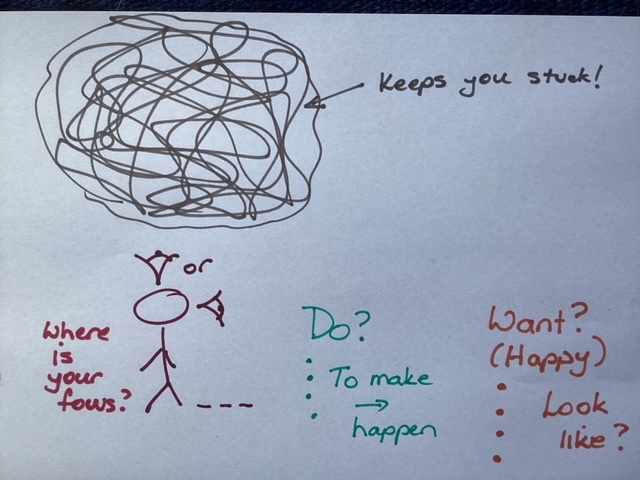
I often use this graphic in my consultations to reflect the internal dynamics of what happens. If we get out of our heads, logic usually informs what needs to be done. Maybe that is leaving a relationship, changing a job, moving someone out, getting on with studies, letting go of someone. Instead of working with the logic of what we know however, many people flip into their heads, rummaging through the various information they have read, what others will think, why they can’t do something, etc. etc. No one ever succeeded in life via that route. They succeed by getting on with things, even if it is new, they haven’t done it before and they are a bit afraid. Courage outweighs unfamiliarity. Because that is how human beings navigate the ‘new’, the ‘unexpected’, the ‘needed’. They get on with it, maybe not perfectly, maybe not even successfully, but they focus on what needs doing and do it.

Just as how we read has changed with the introduction of screen based print and entertainment, so too has how we solve problems. In reading, our automatic (learned to perfection) habit used to be deep attention, neural processing moving from left to right. Now, our automatic (learned to perfection) habit is to quickly scan haphazardly moving our eyes to differing locations, extracting info bytes and departing 3 minutes later. For many, deep reading takes more effort than it used to. With an exponential growth in information, our automatic problem solving skills have also changed. Once, we would have listened to our internal logic about matters and acted. Now we automatically search for the next information source endlessly talking, gathering (info bytes), watching …. but not moving. Our internal logic and wisdom is drowned out by the noise occupying our minds. We are stuck.

Journalling can be very effective in reconnecting with internal logic and taking practical steps. The first question is what do you want? What would your life look like if you had it? What would you have to learn to make it happen? What would you have to give up? Be specific. Give yourself permission to be honest and don’t get distracted by thoughts that critique what surfaces. Trust the train of thought that surfaces. You are not committing. You are just exploring.

Next, list all that you would have to do to make what you want happen? Again don’t get caught up in censoring your capacities and abilities. How do you feel about what you have written? Is trusting yourself and doing what’s right for you a possibility? Write into the apprehension, you may find it doesn’t have a leg to stand on.

When faced with a challenge are you automatically deviating into your head and rattling around in there instead of taking one small step? Because that’s all living is about. Small steps. Taking them one step at a time. Just like a baby learning to walk – thank goodness they can’t read before the task of walking! One step. Learn. Modify. Next step.

Internal Tremors

‘Wishing you a finely tuned, in depth conversation, between your inner most self, and the universal horizon.’ These were the words theologian Sylvia Grevel wrote in response to my revelation that my working life had taken a significant turn. I did not know what lay ahead.

Shifts in alignment between my inner most self and the outer world are erupting. Significant personal and work related incidents since Christmas 2022 have caused me to pause and reflect. My questions and book purchases have also led me to the workshops and supervision provided by Monica Suswin. In one of those encounters, I realised my inner most self was not supported and I needed to respond. I heeded Monica’s warning about unshackling myself too quickly from non nurturing contexts and so I happily continued trusting that I would act when I ‘knew’ what next, and open to the ‘other’ possibility that I may be in the right place.

I spent two glorious weekends away – one with Sylvia – nourishing the inner most me. This monring, I was ready for my working week ahead, and had intended to complete casenotes; write up the draft to a journalling workshop about ‘Writing into (not for) Wellbeing’; and complete a few outstanding admin tasks. But in the background, something else stirred. I knew I had to withdraw from a commitment. Whilst there was no intention to create dissension, I somehow felt that what I was about to do would unsettle everything.

It did.

Whilst the unravelling rolled out, I listened to a webinar interview with Eric Teplitz through my membership with the International Association of Journal Writers, an organisation I recently joined to support the “Journal Writer who happens to work as a Psychologist’. Eric raised questions about whether we thought possibilities sat latent in our lives – we do not know what may surface tomorrow. I realised I hadn’t believed in the possibilities that awaited me for a very long time. Possibilities, in my mind, were exclusive to younger lives.

Eighteen years ago, I turned to my journal to explore the possibility that wisdom lived latent in the darker recesses of my being. It turned out that it was not so latent, that it had been active all my life, and that my only ‘error’ was to not recognise it. A cycle has been completed and I now embark on another one, one that exploits further the power of something invisible but operative – a conversation between my inner most being (wisdom), and the universal horizon.

Since running community markets some years ago, I have been a big believer in putting innovative ideas and thinking on the horizon. Those innovations open up possibilities for everyone. So now I offer another one, one based on not knowing, on listening, on journalling to hear, and on trusting what surfaces. I am not going to do what I may have done in the past to secure my future. I am not going to scramble and put things in place. I am going to explore the possibility that between now and end June 2023, possibilities I could never dream of exist for me. With my journal to capture the questions, to write into the questions, to reveal thoughts and ideas beyond my current ‘stock’, let’s see what unfolds.

Listen and Live

Ageing is niggling in the back of my mind. My body is changing, I am dreaming of leaves in which the chlorophyll has turned yellow, and in a moment of clarity, I woke up and knew I could just as easily die from an unexpected heart attack now as I could from dementia twenty years down the track. Nothing should be taken for granted.

The deeper nuggets of wisdom in the niggle arose out of the realization about the timing of my death. Is my Will up to date? Maybe now is the time to get around to working through an advanced care plan? I need to ensure my meagre assets aren’t devoured by hefty admin costs and I need to ensure I have a say about what happens to me should an unexpected downturn assault my body.

Ageing and death naturally surface in human consciousness as time goes on. As with any other time in life, we can easily get caught up in fearful thinking – and miss the wisdom that sits in the niggle. Many adults plan for retirement – probably because someone makes money out of it and dollars are invested into advertising. Media promotion however creates an expectation of what these periods in our lives should look like and they miss the non monetary forms that many elect. When people listen to the niggles in the back of their mind, a broader range of options resonate.

When it comes to frailty and dying, the two biggest service providers are Residential Aged Care and Funeral Services. Options are appearing on the horizon for lower cost and different form funeral services, eg. Tender Funerals. Advanced Care Planning provides a framework to consider living arrangements when frail, and the timing of a good death rather than a long depersonalized one.

So I listen to the niggle and book an appointment to review my Will. I also dedicate a day to work through the excellent resources available for Advanced Care Planning and Directives. This is inner work, using the questions raised to explore my values, to imagine different scenarios and to influence choices down the track when I may not have the faculties to do so.

Whilst I incorporate the wisdom of the niggles into my tasks, I continue to live what is present. I keep up with my home based exercise regime and walking; I eat healthy, home cooked meals; I work, I laugh, and I care. I enjoy all the the nuances of my life, including this little fella.

A wild bird feeder began as a ‘nice idea’. What I didn’t realise is that they tell their friends and before I knew it, I had flocks fighting in my front yard. Three birds emerged as needing help. Being a clean bird by nature, filth reflects poor health. This one is the healthiest looking of the three. With eyes like dark empty sockets, one looks like Uncle Festus from The Adams Family. Its beak is broken and its feathers are falling out. The other is covered in red dust with mauled tail feathers. I enjoy the slowing down and being present they require in my day.

Listen to the wisdom in the niggles in the back of your mind, continue to live your life, and enjoy its contents. If we get caught up in the fearful thinking that can surface, not only do we not do what’s needed to enable a good end of life, we miss out on all the living in between.

Beliefs Have A ‘Use By’ Date

At the time of writing this post, it is Australia Day. In years gone by, cars could be seen laden with Australian flags; dwellings acquired flagpoles; t-shirts were emblazoned with red, white and blue; and crowd faces looked like the set of Braveheart movie. Festivals were created, bands played, people drank (a lot) and fireworks lit up the sky.

Not so this year. Not one car with a flag sighted locally. Not one painted face. Much less merchandise. Australia Day celebrations silenced.

Not too long ago, voices of dissent to our entrenched interpretation of the day could be heard and different festivals emerged – ones grounded in truth telling about the invasion that usurped the traditional cultures and roles of our indigenous peoples. It soon became clear that the thinking and beliefs that framed our behaviours on 26 January had reached their ‘use by’ date. They no longer served the nation we wish to be.

The same process of change occurs in all of us – if we pay attention. Just as the beliefs underpinning Australia Day were a ‘narrow slice’ on the bigger picture, so too are the beliefs we create in our formative years about ourselves, our potentials, our abilities, our values …. the list goes on. They serve us for a while, but with time, discontent niggles within – a more mature voice wishes to be heard. If we pay attention, change can be peaceful. If not, the limits of our beliefs break and an eruption occurs. Relationships become untenable, health problems erupt, work loses its pizzazz, or we don’t like what we see in the mirror. The tiny, narrow, slivers of understanding we formed in times long gone by about the amazing power of life pulsating through everything, including ourselves, are revealed for the schtick they are.

Australian’s are embracing a different, fuller, more accurate perspective on their national day. Not everyone at the same time, but it is happening. The same occurs with our understanding of ourselves. If we slow down and listen to the niggles, exploring their content, accuracy and relevance to our current contexts, we can wake up to the expiry of the ‘use by’ date of the beliefs that drive us behind the scenes, and be open to what comes next. For change comes from within. The new thoughts that are emerging for our celebrations of this nation come from within individuals, and like a ripple effect, increasingly resonate with those who are open to listening. Deep within, we are all ‘truth seekers’ and in our own lives, the voice of fresh truth also resonates – if we listen.

Change is wired in to the flow of life, including through ourselves. Fresh thought in the form of impulses or words powers every tendril of innovation, creativity and evolution. Downfalls occur when that ‘nudge’ is ignored.

Have you listened to the niggles in the back of your mind? Do you give yourself permission to sit down and explore them through a journal? What fears get in the way? What unfounded fears about your Self sit below them? What changes would you be liberated to embrace and manifest if, like a 2021 bottle of sweet chilli sauce, you threw your beliefs that have passed their expiry date in the bin!

Releasing Resentment

It was one of those nights in which sleep eluded me. My mind was fixated on a conversation that had occurred the day prior and couldn’t let go of the perspective it had taken.

On rising the next morning, I sat with my journal and wrote. Once again, I was blessed with its fruit.

My writing revealed my resentment at someone’s inability to take a stand. Inability is the key word, for they really were unable – but my mind had simply ignored that fact and instead clung on to the incorrect view that the person could take a stand, and should. My ill founded thinking was the cause of my resentment, not the person – but it took my writing to see that.

I wrote about their early life, of the experiences they had endured, and of the mechanisms they had creatively developed to survive. Taking a stand was not one of them. Taking a stand incurred violence. So instead, they learned to hide, and as an adult, to keep ‘messy’ people and ‘messy’ life out of their lives. Whilst voicing strident opinions with an intensity that reflected their fear came easy, acting on them did not.

It made sense. Our early years are the context in which we learn to think so that we survive and stay connected with people. Unconsciously, it becomes our ‘manual’ for navigating life. ‘Don’t speak up’, ‘don’t annoy anyone’, ‘work hard’, ‘don’t try’ and endless others become ‘chapters’ that steer our engagement with life from behind the scenes.

As my writing revealed this person’s history, compassion rippled through my body. I understood how difficult it is to break out of a lifetime of unconscious psychological habit, something that can only occur if we trust the core of who we are. None of this person’s early experiences inserted that ‘chapter’ into their personal ‘manual’. My resentment was ill founded.

If you are feeling resentful towards another and wish to move on, I invite you to sit down and write about the situation on which you have fixated. Articulate on the page what you think the person should have done. Be honest with your recount, because it is this thinking that is getting in the way. Then reflect upon what that person would have needed to know about themselves, and the experiences they would have needed in life, to become the sort of person you expect. Then write about the early life they had and how they learned to survive in that context. It’s no good resenting someone for actions and behaviours they have no idea how to execute or that they are not capable or free to do so. Like canaries in an open cage, rarely is anyone completely psychologically free to live congruent with the active intelligence that animates us. We all possess our own straightjackets.

Always Learning

When we think of learning, what comes to mind? Babies learning to walk, children at school, learning to drive, learning on the job, and learning at university. In these contexts – early childhood, new skills and educational environments – it is easy to identify that learning is taking place. But what about the learning demanded of us when we become new parents? Or learning how to be in relationship? Or the learning required at the tail end of life?

Because the need to learn never ceases – not until our final breath. The older adults I work with in residential care are learning to live in an alien environment; they are learning to live with bodies that lose functioning every day; many are learning to live with impoverished family connections; they are learning to allow strangers to support them; and they are learning to die.

As with all learning, some do it with grace, whilst others struggle. Some only see the loss, and become frightened. Whilst others accept, and see the opportunity for learning about their deeper selves; about the people around them; about relating; about life … and death; and enjoy the final ride.

When our old people in residential care are whining about their medical woes, or their lives, remember two things. (a) They are attempting ‘personhood’ in the best way they know how. By talking about what they know but from within the diminished context in which they now live. Everyone outside residential care has the breadth of life in which to engage, and discourse. They have functional bodies that move in varied contexts, with varied people, with varied purpose. In outside contexts, it is easier to have something to say that others will find interesting and engage with. And, (b) They don’t realise they are learning. In time, if their social circles and engagement with activities increases, their narratives will change. If not, their narratives and vitality will diminish. And if open to learning, what they understand and think will find a depth incomprehensible to those busy with life.

Our older people are learning, and transitioning into residential aged care demands it even more. Validate the learning they are doing. Talk about earlier times in which they valiantly met similar challenges. Talk about what they are noticing in themselves. Get curious about what it is like. Harness their learning. Adjusting (learning) requires that we allow new experiences, people and understanding in. Recognise the inner being learning to adjust to different physical, social, familial, personal and spiritual circumstances. Listen and affirm their efforts. Champion the hero/ine within and help them to flourish as their bodies and lives diminish.

The Nature of Thoughts

If plants possessed attention, where have they pointed it? Is it the same for human beings?

The human mind is a thought generator. Turn it to how much you dislike someone or something and it will generate thoughts aligned with that direction. Turn it to something you are passionate about and it will generate thought aligned with that direction. Unlike plants, we have the free will to turn our attention in whatever direction we choose. To possibility and something fresh … or to the ground hog day of habitual ways of thinking, feeling, talking and acting.

In preparation for a journalling circle recently, I initially turned my attention to memory – to what I knew and how it would structure a probable outcome. But in the back of my mind, an image from a journalling group several years ago, kept ‘knocking’. I wanted the lightness and feeling of that moment in our meeting.

So, I put aside what I thought I should do, and sat with the feeling. The thought came to pick up a book about journalling and browse. Again, my intellect wanted to categorise into useful and not useful, but instead I let the feeling guide me. I resisted the prompt that resonated. ‘List the milestones in your life, add a few details and write about one.’ My head said it was too banal, but I chose to trust the nudge, and wrote up my preparation.

Wow, what a rich time we had. No one writing yielded the boring writing I had anticipated. Everyone accessed something fresh and new.

‘I’m the driving force of my direction.’

‘Living smaller doesn’t mean living smaller.’

‘Whatever is to come, I know I will be okay.’

‘I can choose to enjoy the time before me.’

In the myriad of the words we wrote, a sentence or a phrase in each piece ‘grabbed’ us. The human mind is a thought generator, but not all thoughts are equal. In the midst, deeper truths can be felt. Maybe there is more in common in the Nature that animates us and plants than we think.

Sinkholes in Consciousness

Slap, slap, slap, slap. The sound of sandshoes pummelling the footpath every day as my 9 year old self ran up the hill of the road home in an attempt to beat the bus. 1960’s shoes and shoulder strap school bag didn’t make it easy. If the old bus chugged past before I made it to the top, I’d stop running and stoop into despair that I had ‘lost’. Beat it and I was a winner. The fantasies that go on in a child’s mind. Adrian Mole and Horrible Henry aren’t the only ones narrating their lives.

The only problem is that that narrative became my mantra. Whether in work, or relationships, or health, I have pushed myself beyond what is humanly healthy in order to reach a bar I had set too high in order to validate my worth.

Five decades later, I am finally listening to the nudge within that serves me better than my conditioning. I am called to slow down my inner world, and to let go of the narrative that orders I do this, this and that, before I can feel okay. It’s time to move with grace. It’s also time to prioritize writing about moments that resonate.

So I was disappointed recently to find myself agitated at the end of the day. As I swept the kitchen floor, the realisation came to me that I had been using an hour of DVD watching of an evening as my ‘reward’ for having slowed down during the day. On this day, however, work tasks had taken a little longer and the ‘reward’ was thwarted. No wonder I was tense! How grateful I was for the fruits in awareness the disruption unearthed.

Oh I was amused. Like a sinkhole in consciousness, this childhood cognitive firing was at play again! Conditioning had usurped open presence. My mind had automatically made ‘reward’ meaning out of time at the end of the day. Realisation freed me and I knew there were no ‘rules’ about how I used my time. Categorising my activity into work, or leisure, or reward, was all made up! The truth is that every moment is full of possibility – and I am free to follow the internal nudge.

Another wonderful lesson from life on how to avoid habitual cognitive sinkholes. Slow your mind down, be present to where you are, and step into the nudge from within.

What if we’ve got ourselves all wrong?

What if we’ve got our understanding of ourselves all wrong? What if we’ve got our thinking about how we need to use thinking all wrong? What if the innate capacities that drove Neanderthal man forward in evolution (without a book or teacher) are just as present in modern day man? What if, just as those capacities enabled Neanderthal man to successfully navigate his context, they are just as available for successfully navigating our context, and the contexts of the future? What if the way we think we have to relentlessly think about everything in order to live well is actually getting in the way of the capacities inbuilt to human beings that are the real drivers of change, thriving and evolution?

Innocently, we may have taken a wrong turn and the pendulum has swung too far out. Like mushrooms spawning, books, information and websites on how to manage our emotions, psychological states, parenting, relationships, business, performance, etc. now envelope our lives, each of them telling us how to do this, how to do that. It is humanly impossible to do everything they say, and yet each proposes that its contents will make us more effective – the implication being we will fail if we don’t. No wonder anxiety is so prevalent. Is it really true that we innately lack the wherewithal to successfully navigate life without an ‘expert’ somewhere guiding us? Or have we innocently lost our way and lost sight of what makes us human – the capacity to successfully navigate all the complexities of life – if we slow down the busyness of our thinking.

What if we settled back into an assumption that we have got what it takes and let go of running to do lists, schedules, books to read, classes to attend …. being in control. What if we played with letting that internal state go and gave ourselves permission to experiment? What if we maintained a quiet inner state for a small part of each day, what would we discover about what Neanderthal man innately trusted because he had never been taught to doubt it?

Bending Reality Out of Shape

When people come into counselling, I suspect they think that if we just talk about everything, that in some miraculous way, it ‘fixes up’ the content of whatever is going on. The problem is there is SOOOO MUCH going on.

People not liking what we have done, people wanting more from us, unhealthy workplaces, poor relationships, addictions, people dying, sickness, struggling children … the list is endless. All of these issues benefit from a bigger perspective conversation. But the amount of time this would take is unreasonable, and new ‘problems’ surface along the way.

As part of her current More Signal, Less Noise 5 Day training Barbara Patterson presented a simple understanding of how everyone perceives in the moment – including ourselves. We are either interpreting life (and ourselves) from clarity, or we are interpreting from an agitated internal state and our thinking distorts reality. It bends it out of shape.

See the actions of a family member in a clear state and we see their acts of kindness and care. See it from an agitated state, and we distort our attention and thinking, catastrophising one small detail. See our own agitated internal state from clarity and we experience compassion. See the same internal state from agitation and we distort our experience into shame. Sensing whether ourselves and/or others have a calm internal climate or an agitated one, makes all the difference in knowing whether we, or others, are seeing clearly, or whether thinking is distorting reality.

Knowing this simple understanding provides flexibility in response as against groundhog day of repeated neural firing. If I know I am perceiving from an agitated internal climate, I can choose to sit still, breathe, redirect my attention, listen, etc. If I can see that the other person is expressing from an internal agitated state, I can choose to calm them down, distract, or I can walk away.

Everything going on in a person’s life can’t be talked through and ‘settled’ into place. But everyone can discern whether they and/or others are seeing clearly, or are innocently distorting reality. Familiarising ourselves with this simple ‘tool of awareness’ then opens a portal to forming a conscious relationship with the Me behind all the distorted thinking. The Me that nudges, realises, insights and knows – even when an internal tsunami is underway.